Shell in Traditional Indian Vaastu
In traditional Indian Vaastu Shastra, the shell or Shankh is considered a sacred symbol of purity, prosperity, spiritual energy, and divine vibrations. Inspired by the ocean and associated with Lord Vishnu, shell motifs have been used in ancient temples, havelis, palaces, and classical Indian architecture for centuries.
The shell represents the water element (Jal Tattva), which symbolizes calmness, abundance, emotional balance, and positive energy flow within a space.
Spiritual Significance of Shell (Shankh)
According to ancient Indian traditions, the sound of the Shankh creates powerful vibrations that purify the surroundings and remove stagnant or negative energy. Shell patterns and carvings were often incorporated into architecture to create harmony, beauty, and auspiciousness.
The shell also symbolizes:
- Prosperity and wealth
- Protection from negative energies
- Spiritual upliftment
- Divine blessings
- Expansion and growth
Best Directions for Shell Motifs in Vaastu
The placement of shell symbols and shell-inspired architectural designs plays an important role in Vaastu.
| Direction | Vaastu Effect |
|---|---|
| North-East (NE) | Spiritual growth and peace |
| East | Positivity, recognition, vitality |
| ENE (East-North-East) | Creativity and refined energy |
| North | Prosperity and financial flow |
Avoid excessive shell motifs in South-West and South zones, as these areas require stability and grounding energy.
For ENE (East-North-East) and E (East), shell or Shankh motifs are generally considered quite positive in Vaastu, especially on façade ornamentation, arches, medallions, niches, or pediments like your reference.
ENE (East-North-East)
This zone is associated with:
| Aspect | Meaning |
|---|---|
| Devta energy | Rising spiritual intelligence |
| Element | Transition of Water + Air |
| Nature | Inspiration, clarity, creativity |
| Psychological impact | Vision, refinement, aesthetics |
Shell Motif in ENE
Very favorable for:
- artistic architecture
- elegant classical detailing
- intellectual and creative homes
- spiritually refined energy
The flowing shell geometry works well here because ENE likes:
- movement
- refinement
- graceful curves
- openness
Best Use in ENE
| Placement | Effect |
|---|---|
| Arch crown | Excellent |
| Balcony medallion | Good |
| Window top ornament | Very good |
| Decorative niche | Positive |
| Fountain + shell combination | Strongly favorable |
Avoid in ENE
- overly heavy shell carvings
- dark colors
- aggressive baroque overload
- broken or cracked shell forms
ENE should feel:
light + uplifting + refinednot heavy.
E (East)
East is ruled by:
| Aspect | Meaning |
|---|---|
| Energy | Sunrise, vitality |
| Devta | Indra / Surya influence |
| Element | Air + subtle solar energy |
| Symbolism | Reputation, visibility, social recognition |
Shell Motif in East
Very auspicious.
Especially for:
- façade identity
- main elevation
- statement architecture
- prestige homes
- institutions
- villas
Because shell geometry naturally radiates outward, it symbolically amplifies:
- recognition
- visibility
- prestige
- welcoming energy
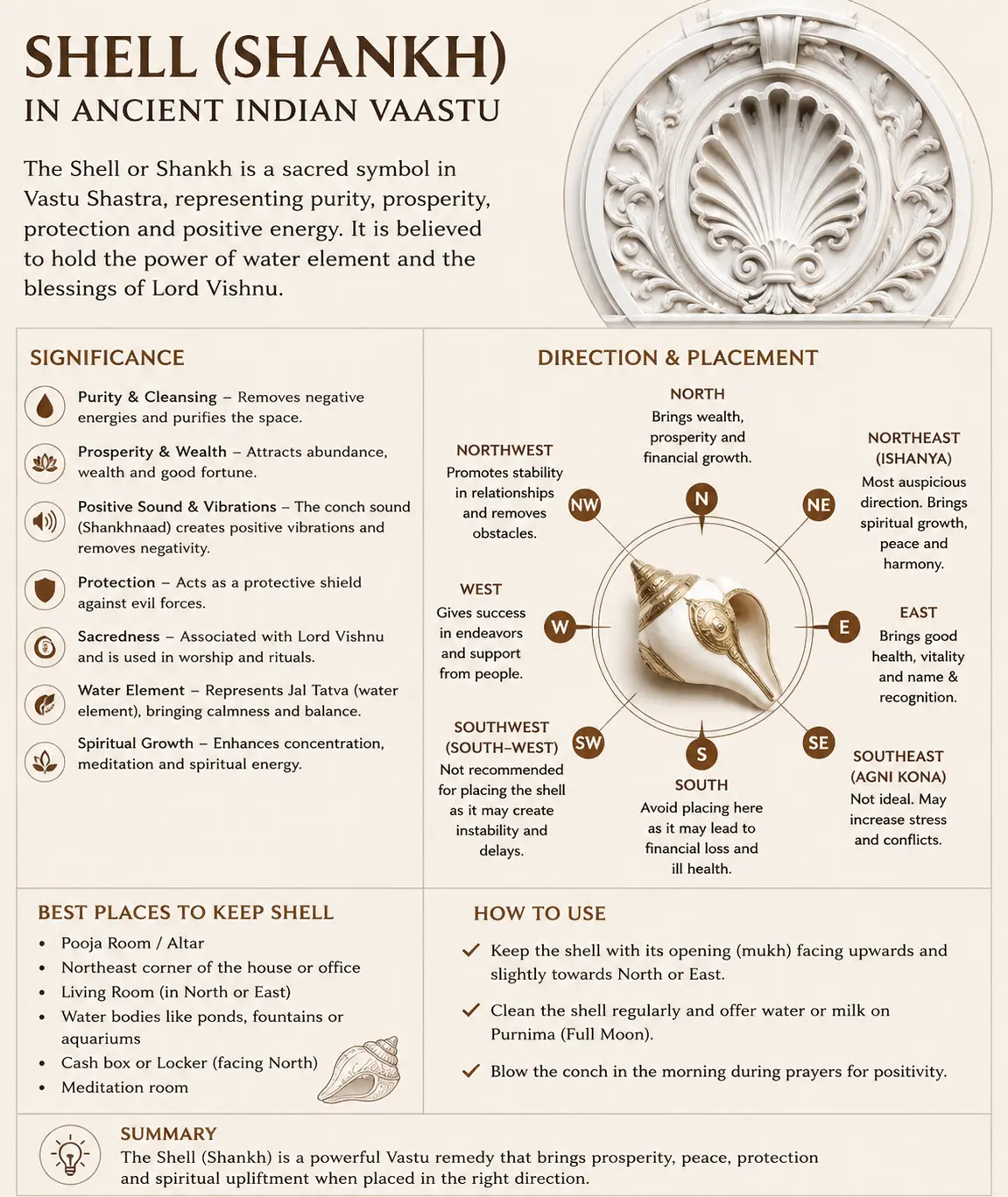
Shell Motifs in Traditional Indian Architecture
Ancient Indian architecture frequently used shell-inspired carvings in:
- Entrance arches
- Temple façades
- Decorative medallions
- Balcony crowns
- Niches and domes
These flowing geometries helped soften harsh architectural lines and created a graceful visual rhythm.
Modern Vaastu Use of Shell Designs
Today, shell motifs crafted in cement sand work, GRC, marble dust finish, or stone carving are becoming popular in luxury villas and classical façades. Off-white shell medallions in East or North-East facing elevations create an elegant and spiritually uplifting appearance.
Conclusion
The shell (Shankh) is more than a decorative element in Indian Vaastu. It is a timeless sacred symbol representing prosperity, harmony, divine vibrations, and positive energy flow. When thoughtfully placed in the right direction, shell motifs can enhance both the spiritual and architectural beauty of a space.
Why Ancient Architecture Used Shell in Arches
Your image resembles:
- Rajput architecture
- Haveli ornamentation
- Indo-European classical fusion
- Temple-inspired façade carving
Shells were placed:
| Location | Purpose |
|---|---|
| Arch center | Energy focal point |
| Entrance crown | Welcome prosperity |
| Window pediments | Soften sunlight & energy |
| Niches | Sacred ornament |
| Dome interiors | Acoustic symbolism |
Symbolic Geometry of Shell
The shell expands outward in radiating curves.
This signifies:
- expansion
- radiating energy
- manifestation
- growth from a central bindu
In Vaastu terms:
Bindu → Expansion → ManifestationVery similar to lotus symbolism.
Spiritual Meaning
In Sanatan tradition:
Shankh represents:
- Vishnu tattva
- Cosmic sound
- Creation vibration
- Ocean consciousness
- Life emergence
Temple priests use conch because:
- vibration purifies space
- breaks stagnant energy
- activates pranic movement
Thus shell motifs in architecture symbolically keep the structure “alive”.
Direction-wise Recommendation for Your Villa
Since your villa is neoclassical/Victorian inspired, shell motifs work beautifully in:
| Placement | Recommendation |
|---|---|
| East façade pediment | Excellent |
| NE façade arch | Best |
| Balcony arch center | Very good |
| Entrance crown | Prosperity symbolism |
| Window top medallion | Elegant and Vaastu-friendly |
Ideal Material
For authentic traditional look:
| Material | Recommendation |
|---|---|
| Cement sand molding | Excellent |
| GRC | Better precision |
| White cement + marble dust | Premium finish |
| FRP | Avoid for premium classical façade |
Ideal Proportion
For façade shell medallion:
| Element | Ratio |
|---|---|
| Circle diameter | 1x |
| Shell height | 0.7x |
| Projection depth | 2 to 4 inches |
| Groove count | 9, 11, or 13 ribs preferred |
Odd-number ribbing was traditionally considered more harmonious.
Ancient Indian Equivalent
Indian temple architecture often used:
| Motif | Similarity |
|---|---|
| Shankh | Direct shell symbolism |
| Padma | Radial sacred geometry |
| Kirtimukha framing | Protective ornament |
| Jal-tarang carvings | Water flow symbolism |

Leave a comment
Your email address will not be published. Email is optional. Required fields are marked *