
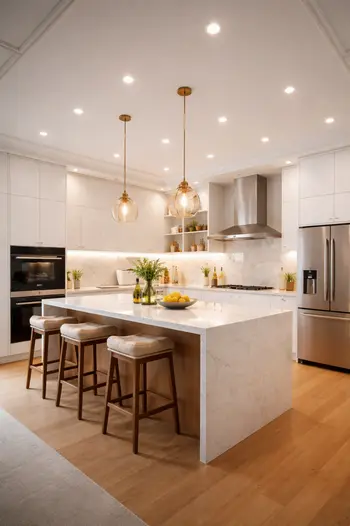
Placement, Color Temperature and Modern Lighting Setup
The kitchen is one of the most functional and expensive spaces in a home. People carefully choose cabinets, colors and materials, but one crucial element is often ignored.
Poor lighting can create shadows, reduce efficiency and make cooking uncomfortable. A properly designed lighting system can transform the kitchen into a bright, efficient and aesthetically pleasing workspace. In this guide we will explore the complete kitchen lighting system used by professional interior designers.
1 Ceiling Lighting for Kitchen
The first layer of kitchen lighting is ceiling lighting.
Two common options are used
Panel lights
COB lights
For kitchens, panel lights are always preferred.
COB lights produce focused light at narrow angles which creates dark areas inside cabinets. Panel lights spread light evenly across the entire kitchen.
2 Correct Placement of Ceiling Lights
One of the biggest mistakes people make is placing lights too close to the wall.
If lights are placed near the wall, upper cabinets create shadows on the countertop.
To avoid this problem, follow a simple rule.
If upper cabinets are 12 inches deep, the ceiling lights should be placed 2 feet away from the wall.
This ensures the light falls directly over the working area.
3 Ideal Light Color for Kitchen
Lights generally come in three colors
Warm white
Natural white
Cool white
Warm white creates a relaxed ambience but reduces alertness.
Since the kitchen is a workspace, cool white lighting is the most suitable option for ceiling lights.
If the kitchen is connected to the living room, natural white can also be used for better visual harmony.
4 How Many Lights Are Required
To calculate the required lighting intensity, use a simple formula.
Multiply the kitchen area by 0.65.
Example
Kitchen size = 10 × 10 feet
Area = 100 sq ft
100 × 0.65 = 65 watts
This means the kitchen should have approximately 65 watts of total lighting.
You can achieve this with multiple smaller lights.
5 Countertop Lighting
Countertop lighting is one of the most important layers of kitchen illumination.
These lights are installed below the upper cabinets to illuminate the working surface.
The best option for countertop lighting is
Profile LED lights
These lights provide uniform illumination across the entire slab.
COB lights should be avoided here because they create uneven lighting patterns.
6 Placement of Counter Lights
Counter lights can be placed in three positions.
Near the wall
Middle of the cabinet
Front edge of the cabinet
The best position is towards the front edge of the cabinet, as it distributes light evenly across the slab.
7 Optional Kitchen Lighting Elements
Once the basic lighting is complete, optional lighting layers can enhance the kitchen design.
Pendant Lights
Used above breakfast counters or kitchen islands.
These lights should hang about 36 inches above the counter surface.
Pendant lights usually use warm white light to create a decorative effect.
Cabinet Lighting
If cabinets have glass panels, profile lights inside the cabinet can create a premium appearance.
These lights highlight crockery and decorative items.
Base Cabinet Lighting
Lights installed below cabinets create a floating visual effect and improve night visibility.
These are usually installed using profile lights.
Motion Sensor Lighting
Motion sensor lights can be installed near the floor or skirting area.
These automatically turn on when someone enters the kitchen at night.
This feature is particularly useful for late night use.
8 Ceiling Design Considerations
Kitchen ceilings should be simple and practical.
Avoid installing
cove lighting
deep false ceilings
Cooking fumes and oil particles can accumulate inside these areas, making maintenance difficult.
A plain ceiling with well placed panel lights is the most efficient design.
9 Common Kitchen Lighting Mistakes
Many kitchens suffer from poor lighting due to common design mistakes.
Using only one ceiling light
placing lights behind cabinets
using warm lights for cooking area
ignoring counter lighting
Avoiding these mistakes can significantly improve kitchen usability.
Conclusion
Kitchen lighting is not just about brightness. It is about creating a layered lighting system that supports cooking, preparation and aesthetics.
A well designed kitchen lighting plan includes
Ceiling panel lights for general illumination
Countertop profile lights for work areas
Decorative pendant lights for style
When these layers are combined properly, the kitchen becomes a comfortable, efficient and visually appealing workspace.

Leave a comment
Your email address will not be published. Email is optional. Required fields are marked *