
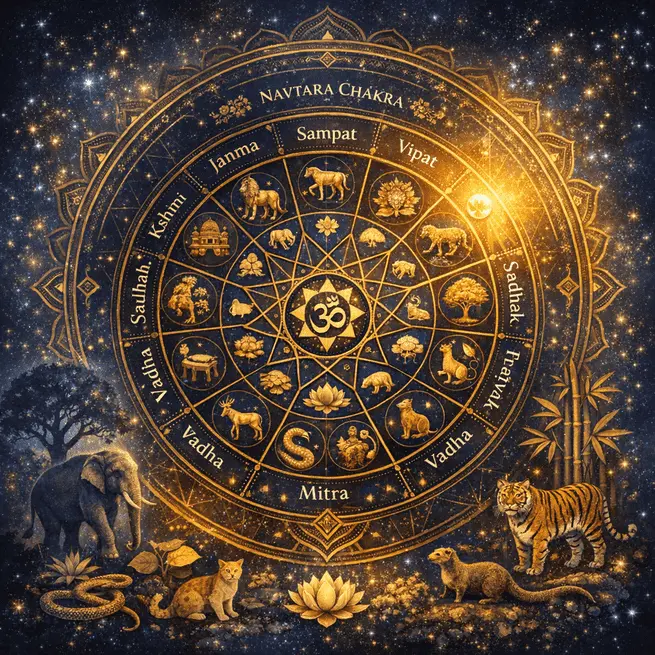
Sampat Nakshatra and Wealth
The Hidden Wisdom of Plants and Animals in Vedic Astrology
Vedic astrology contains many layers of knowledge that extend far beyond simple predictions. One of the most subtle and profound frameworks within Nakshatra based astrology is the Navtara Chakra. While many astrologers are familiar with the 27 Nakshatras, very few explore how these stars interact with one another through the Navtara cycle.
Among the nine positions in this cycle, the Sampat Nakshatra is particularly significant because it represents the energy that supports prosperity, resources and wealth.
Ancient sages did not explain prosperity merely through planets or houses. Instead they encoded the wisdom of wealth through nature itself, using the symbolism of plants and animals connected with Nakshatras. These natural metaphors reveal how prosperity grows, survives and multiplies.
Understanding this connection between Nakshatras and nature allows us to see wealth not as a stroke of luck but as a result of aligning our behaviour with cosmic principles.
Introduction to Navtara Chakra
The Navtara Chakra divides the 27 Nakshatras into nine functional groups based on their relationship with the birth Nakshatra.
The nine categories are:
- Janma Tara
- Sampat Tara
- Vipat Tara
- Kshema Tara
- Sadhaka Tara
- Pratyari Tara
- Vadha Tara
- Mitra Tara
- Ati Mitra Tara
Each Nakshatra occupies one of these roles relative to a person's birth star.
Among them, Sampat Tara is the Nakshatra that governs prosperity and material resources.
In the sequence of stars, Sampat Nakshatra is simply the second Nakshatra counted from the birth Nakshatra.
For example:
If the birth Nakshatra is Ardra, the Sampat Nakshatra becomes Punarvasu.
If the birth Nakshatra is Purva Ashadha, the Sampat Nakshatra becomes Uttara Ashadha.
If the birth Nakshatra is Uttara Bhadrapada, the Sampat Nakshatra becomes Revati.
However the deeper significance lies not merely in the position but in the qualities represented by that Nakshatra.
Concept of Sampat Nakshatra
The Sanskrit word Sampat means prosperity, wealth, assets and abundance.
But the sages did not define wealth as only money. Wealth was seen as the result of:
• discipline
• patience
• resilience
• leadership
• networks
• knowledge
Each Sampat Nakshatra therefore represents a specific behavioural quality that unlocks prosperity.
Instead of explaining these qualities abstractly, the sages used nature based symbolism to convey them.
This is where plants and animals become extremely important.
Philosophy of Plants and Animals in Nakshatras
Ancient Indian knowledge systems often used nature as a teaching medium.
Plants demonstrate how growth occurs over time, while animals demonstrate how survival strategies operate in the world.
By associating Nakshatras with particular plants and animals, sages created a symbolic language that encoded life lessons.
The plant associated with a Nakshatra reveals how prosperity grows in nature.
The animal associated with a Nakshatra reveals how prosperity survives challenges.
When both principles are understood together, the path toward sustainable wealth becomes clearer.
For example:
A bamboo plant teaches patience and invisible growth.
A mango tree teaches maturity before harvesting fruit.
An elephant symbolizes patience and strength.
A mongoose represents courage against poisonous opposition.
These natural metaphors form the philosophical foundation behind Sampat Nakshatra interpretation.
Complete Sampat Nakshatra Table
Below is a conceptual table explaining how each birth Nakshatra relates to its Sampat Nakshatra and the symbolic lesson drawn from nature.
Understanding Prosperity through Plants and Animals
Ashwini Nakshatra
Tree: Kuchla
Animal: Horse
The horse is a symbol of speed, vitality and initiation. In ancient civilizations horses were not only used for transportation but also represented power and expansion. A kingdom with strong horses could travel farther, trade faster and conquer new territories.
Similarly, the Kuchla tree is known for its powerful medicinal properties. Though toxic in raw form, when processed correctly it becomes an important medicinal ingredient in Ayurveda. This transformation teaches an important lesson about potential energy.
The prosperity philosophy of Ashwini lies in activation of dormant potential. Wealth begins when one has the courage to take the first step. Opportunities favor those who move quickly and decisively. Just as a horse begins a journey with a powerful leap, Ashwini natives attract prosperity when they act without hesitation.
Bharani Nakshatra
Tree: Amla
Animal: Elephant
The elephant is one of the most powerful symbols of endurance in nature. It moves slowly but carries enormous weight. In ancient times elephants were used for construction, warfare and transportation of heavy loads.
The Amla tree represents nourishment and longevity. It produces fruit that strengthens the body and enhances immunity.
Together these two archetypes convey a deep message about wealth.
Prosperity is rarely created through speed alone. It is built through the ability to carry responsibilities for long periods of time. Bharani teaches that wealth belongs to those who are capable of bearing life's weight without collapsing under pressure.
The amla tree nourishes the body just as discipline nourishes prosperity. The elephant reminds us that steady endurance creates lasting success.
Krittika Nakshatra
Tree: Udumbara (Cluster Fig)
Animal: Goat
The goat is known for its remarkable survival ability. It can climb steep mountains and survive in landscapes where other animals cannot.
The Udumbara tree grows in challenging conditions and produces fruit that sustains wildlife.
The wealth philosophy here revolves around purification and resilience. Krittika is governed by the element of fire, which burns away impurities.
Just as the goat finds nourishment in rocky terrain, prosperity often emerges when a person learns to thrive in difficult circumstances. Krittika teaches that wealth grows when one removes unnecessary distractions and focuses only on what truly matters.
Rohini Nakshatra
Tree: Jamun
Animal: Serpent
Rohini represents fertility and abundance. The Jamun tree produces rich fruit that nourishes entire ecosystems.
The serpent symbolizes magnetism, attraction and hidden power.
In nature, fertile environments attract life automatically. Similarly, prosperity grows where creativity, beauty and nourishment exist.
Rohini teaches that wealth is often attracted rather than chased. When individuals create environments that support growth and harmony, opportunities begin to flow naturally toward them.
Mrigashira Nakshatra
Tree: Khadir
Animal: Deer
The deer constantly searches for new pastures and water sources. Its survival depends on curiosity and movement.
The Khadir tree produces strong wood used in construction and medicinal preparations.
Together they represent the balance between exploration and stability.
Prosperity rarely comes from remaining stagnant. New ideas, new markets and new connections often emerge when one explores beyond familiar territories.
Mrigashira therefore teaches that wealth is discovered through curiosity, exploration and willingness to seek new horizons.
Ardra Nakshatra
Tree: Agarwood
Animal: Dog
Agarwood becomes valuable only after the tree undergoes internal transformation caused by natural infection. This process produces the fragrant resin for which the tree is famous.
The dog represents loyalty and emotional resilience.
The symbolism here is profound. Many of life's greatest achievements emerge after periods of emotional turbulence. Just as storms cleanse the atmosphere, challenges often reshape character.
Ardra teaches that wealth often arises from transformation through adversity.
Punarvasu Nakshatra
Tree: Bamboo
Animal: Cat
Bamboo is one of nature's most extraordinary plants. For several years after planting, it grows silently beneath the soil, developing an extensive root network. Then suddenly it rises rapidly toward the sky.
The cat represents patience and silent observation.
The wealth philosophy here is the principle of invisible preparation. Many people abandon their efforts when results are not immediately visible.
Punarvasu teaches that unseen preparation eventually leads to explosive growth.
Pushya Nakshatra
Tree: Peepal
Animal: Goat
The Peepal tree has been revered for thousands of years because it supports countless life forms. It provides shelter, oxygen and medicinal value.
The goat represents adaptability and nourishment.
Pushya teaches that prosperity grows when individuals create systems that nourish others. Wealth flows naturally toward those who become sources of support and stability for their communities.
Ashlesha Nakshatra
Tree: Nagkesar
Animal: Cat
The Nagkesar flower is subtle but powerful in medicinal value.
The cat moves silently, observing its surroundings carefully before acting.
Ashlesha teaches the wealth philosophy of strategic intelligence. Prosperity is not always achieved through direct confrontation. Often it requires observation, understanding hidden dynamics and acting with precision.
Magha Nakshatra
Tree: Banyan
Animal: Rat
The Banyan tree spreads enormous roots and branches, creating entire ecosystems beneath its shade.
The rat symbolizes survival and resource storage.
Magha represents the philosophy of legacy. Wealth is sustained when strong foundations are built and resources are preserved carefully.
Purva Phalguni Nakshatra
Tree: Palash
Animal: Rat
The Palash tree is famous for its bright orange blossoms that appear even when the tree seems dry and lifeless. It reminds us that beauty and vitality can emerge even from periods of apparent inactivity.
The rat represents resourcefulness and the ability to locate hidden food sources even in the most unlikely places.
Together these archetypes teach that prosperity often appears through creativity and hidden opportunities. When a person develops the ability to recognize possibilities that others overlook, wealth begins to flow naturally.
Purva Phalguni therefore represents the prosperity of creative expression and intelligent resource discovery.
Uttara Phalguni Nakshatra
Tree: Plaksha (Sacred Fig variety)
Animal: Cow
The sacred fig family of trees provides shade, nourishment and ecological balance. It becomes a central point where many life forms gather.
The cow has long symbolized nurturing abundance in Indian culture. It provides nourishment continuously without destroying its surroundings.
This Nakshatra teaches that prosperity expands through cooperation and mutual support. Wealth built through partnerships, alliances and social harmony tends to be more stable than wealth created in isolation.
Uttara Phalguni shows that when relationships are based on trust and shared purpose, prosperity becomes sustainable.
Hasta Nakshatra
Tree: Jasmine
Animal: Buffalo
The fragrance of jasmine spreads gently but reaches far distances. Its influence is subtle yet powerful.
The buffalo symbolizes hardworking strength and the ability to sustain long hours of physical effort.
Together they represent the philosophy that prosperity emerges when skillful work is combined with dedication. A person's hands become instruments of creation. Whether through craft, art, technology or service, the ability to transform effort into value becomes the source of wealth.
Hasta reminds us that prosperity is often the result of mastery over one's craft.
Chitra Nakshatra
Tree: Bilva
Animal: Tiger
The Bilva tree is sacred and strongly associated with divine architecture and sacred geometry. Its leaves are used in many rituals symbolizing balance and precision.
The tiger hunts with patience and accuracy. It does not waste energy chasing every opportunity but waits for the right moment.
Chitra represents the prosperity that emerges through precision, design and strategic action. Wealth grows when ideas are executed with attention to detail and aesthetic harmony.
This Nakshatra teaches that true success lies not merely in effort but in beautifully crafted effort.
Swati Nakshatra
Tree: Arjuna
Animal: Buffalo
The Arjuna tree is known for its remarkable strength and ability to stand firm along riverbanks where soil erosion is common.
The buffalo symbolizes endurance and steady effort.
Swati represents the prosperity that arises from independence and adaptability. Like a plant bending in the wind but never breaking, individuals who maintain flexibility while protecting their core values often achieve long lasting success.
Wealth grows when one learns to move with changing circumstances while remaining rooted in strength.
Vishakha Nakshatra
Tree: Sandalwood
Animal: Tiger
Sandalwood is one of the most valuable trees in the world, yet it grows extremely slowly. Its fragrance becomes more powerful as the tree matures.
The tiger symbolizes focused determination.
Together they reveal the philosophy that prosperity built slowly with discipline becomes extremely valuable over time. Vishakha teaches that patient ambition and focused effort eventually produce extraordinary results.
Anuradha Nakshatra
Tree: Bakula
Animal: Deer
The Bakula tree produces fragrant flowers that are often associated with devotion and harmony.
The deer represents grace and cooperation within groups.
This Nakshatra teaches that prosperity expands through friendship, loyalty and shared growth. Networks built on trust and mutual respect create opportunities that no individual could achieve alone.
Anuradha shows that wealth multiplies when relationships are nurtured carefully.
Jyeshtha Nakshatra
Tree: Neem
Animal: Deer
The Neem tree protects ecosystems through its natural antibacterial properties. It purifies the environment around it.
The deer symbolizes alertness and sensitivity.
Jyeshtha represents the prosperity that arises from responsibility and protection of resources. Those who develop wisdom and leadership become guardians of wealth rather than merely consumers of it.
Mula Nakshatra
Tree: Bamboo
Animal: Dog
The roots of bamboo spread extensively beneath the soil before visible growth occurs. These roots anchor the plant deeply.
The dog symbolizes loyalty and perseverance.
Mula represents the prosperity that arises from rebuilding systems from their roots. Sometimes true wealth requires dismantling outdated structures and creating stronger foundations.
Transformation becomes the gateway to renewal.
Purva Ashadha Nakshatra
Tree: Ashoka
Animal: Monkey
The Ashoka tree symbolizes vitality, courage and victory. It has long been associated with celebrations and positive transformation.
The monkey represents curiosity, experimentation and intelligence.
Purva Ashadha teaches that prosperity often emerges from bold exploration and fearless experimentation. Those who are willing to try new approaches often discover opportunities that others hesitate to pursue.
Uttara Ashadha Nakshatra
Tree: Jackfruit (Panasa)
Animal: Mongoose
The jackfruit tree produces large nourishing fruits capable of feeding many people. It symbolizes abundance and nourishment.
The mongoose is famous for its ability to confront venomous snakes fearlessly.
This Nakshatra teaches that prosperity grows through courage and resilience against criticism or opposition. Many successful individuals encounter negativity during their journey. Those who remain fearless eventually emerge victorious.
Shravana Nakshatra
Tree: Banana
Animal: Monkey
The banana plant is one of the most generous plants in nature. Almost every part of it can be used for nourishment or utility.
The monkey represents curiosity and learning through observation.
Shravana teaches that prosperity emerges through learning, listening and sharing knowledge. Wisdom gained through attentive observation becomes a powerful asset.
Dhanishta Nakshatra
Tree: Shami
Animal: Lion
The Shami tree survives even in desert conditions where other plants struggle.
The lion symbolizes leadership and authority.
Dhanishta represents the prosperity that comes from organizational ability and leadership. Those who can coordinate people and resources effectively create systems of abundance.
Shatabhisha Nakshatra
Tree: Kadamba
Animal: Horse
The Kadamba tree flourishes during the monsoon and supports a diverse ecological environment.
The horse symbolizes movement and expansion.
Shatabhisha teaches that prosperity often arises through innovation and unconventional thinking. Those who explore new fields and ideas frequently create breakthroughs.
Purva Bhadrapada Nakshatra
Tree: Mango
Animal: Lion
The mango tree requires time to mature before it produces fruit of great sweetness.
The lion represents power and authority.
Purva Bhadrapada teaches that prosperity grows when vision is supported by disciplined effort and leadership. Early success must be handled carefully to ensure long term stability.
Uttara Bhadrapada Nakshatra
Tree: Neem
Animal: Cow
Neem purifies environments and protects life from disease.
The cow symbolizes nurturing abundance and stability.
This Nakshatra represents prosperity that emerges through wisdom, maturity and service to others. Wealth that supports the wellbeing of society becomes enduring.
Revati Nakshatra
Tree: Mahua
Animal: Elephant
The Mahua tree nourishes entire ecosystems by providing food, medicine and shelter.
The elephant symbolizes patience and immense strength.
Revati teaches that prosperity develops slowly but becomes extremely powerful when built on patience, compassion and long term vision.
Final Insight
The philosophy of Sampat Nakshatra reveals a powerful truth.
Wealth is not only determined by planetary combinations. It also depends on the qualities we cultivate within ourselves.
Plants show us how prosperity grows.
Animals show us how prosperity survives.
When human behavior aligns with these natural principles, abundance emerges naturally.
This is the deeper wisdom hidden within the Nakshatra system.

Leave a comment
Your email address will not be published. Email is optional. Required fields are marked *