
The Published paper can be downloaded from link: https://ijsrem.com/download/an-elemental-framework-for-vaastu-aligned-plant-systems-integrating-ayurveda-ecology-and-directional-energetics/
1.INTRODUCTION
Across all classical Indian sciences, creation is explained through five basic elements: Earth, Water, Fire, Air and Space. These elements form everything—from soil to the human body, from the sky to the smallest leaf.
Ayurveda looks at these elements inside the body through diet, herbs, digestion and temperament.
Vaastu looks at the same elements outside the body through building orientation, airflow, sunlight and layout.
Plants naturally connect these two worlds.
- They take sunlight, air and water and convert them into Prana.
- They stabilize the environment around them.
- They influence human emotions, body rhythms and energy levels.
Ancient sages recognized that plants do much more than provide shade or food. They create harmony between the space we live in and the body we live with.
- A Tulsiplant purifies the Brahmasthan (center).
- Neem supports purification and airflow when placed in the North-West(Outside boundary).
- Peepalpromotes spiritual upliftment in the East (Temple).
- Banyangives grounding strength in the southwest(not in house boundary).
By understanding these natural qualities, we can create environments where flora, architecture and human well-being support each other in a seamless way.
2. Ayurveda and the Five Elements
Ayurveda teaches that every plant is made of the five elements. But one or two elements dominate and determine its overall behaviour.
2.1 Elemental Dominance
A plant’s effect comes from its elemental makeup:
Earth-dominant plants are heavy, stabilizing and nourishing (e.g., Banyan, Ashwagandha).
Water-dominant plants are cooling, soothing and moist (e.g., Aloe, Lotus).
Fire-dominant plants are heating, cleansing and stimulating (e.g., Ginger, Pepper).
Air-dominant plants are light, mobile and purifying (e.g., Neem, Tulsi).
Space-dominant plants are subtle, fragrant and uplifting (e.g., Jasmine, Sandalwood).
2.2 The Human Connection: Doshas
The same elements form the three doshas:
Vata = Air + Space
Pitta = Fire + Water
Kapha = Water + Earth
When we live around plants whose elemental profile matches our body’s needs, it creates natural balance. For example:
People with excess heat (Pitta) benefit from cooling plants in their surroundings.
People with high Vata benefit from grounding, earthy trees.
People with heavy Kapha benefit from aromatic, air-purifying shrubs.
In this way, the environment becomes a silent healer.
3. Rasapanchaka: The Ayurvedic Blueprint of Plants
Ayurveda describes plants through five parameters, known as Rasapanchaka. This system is simple yet deeply scientific.
3.1 Rasa (Taste)
Taste is the first indicator of a plant’s elemental nature:
| Taste | Elements | Main Action |
| Sweet | Earth + Water | Nourishing, grounding |
| Sour | Earth + Fire | Digestive |
| Salty | Water + Fire | Softening, cleansing |
| Pungent | Fire + Air | Stimulating, drying |
| Bitter | Air + Space | Detoxifying, clarifying |
| Astringent | Air + Earth | Healing, contracting |
3.2 Guna (Qualities)
Qualities describe how a plant “feels”:
- Heavy or light
- Dry or oily
- Cool or warm
These qualities arise directly from the elemental combination inside the plant.
3.3 Virya (Potency)
Virya explains whether the plant produces:
- a heating effect (like Ginger), or
- a cooling effect (like Aloe Vera).
3.4 Vipaka (Post-digestive Effect)
This describes what the plant does after digestion:
- Sweet → builds strength
- Sour → sharpens metabolism
- Pungent → cleans and reduces heaviness
3.5 Prabhava (Special Effect)
Prabhava is the plant’s unique, unexplainable power.
Example:
Tulsi is heating in nature but still calms the mind—this is its Prabhava.
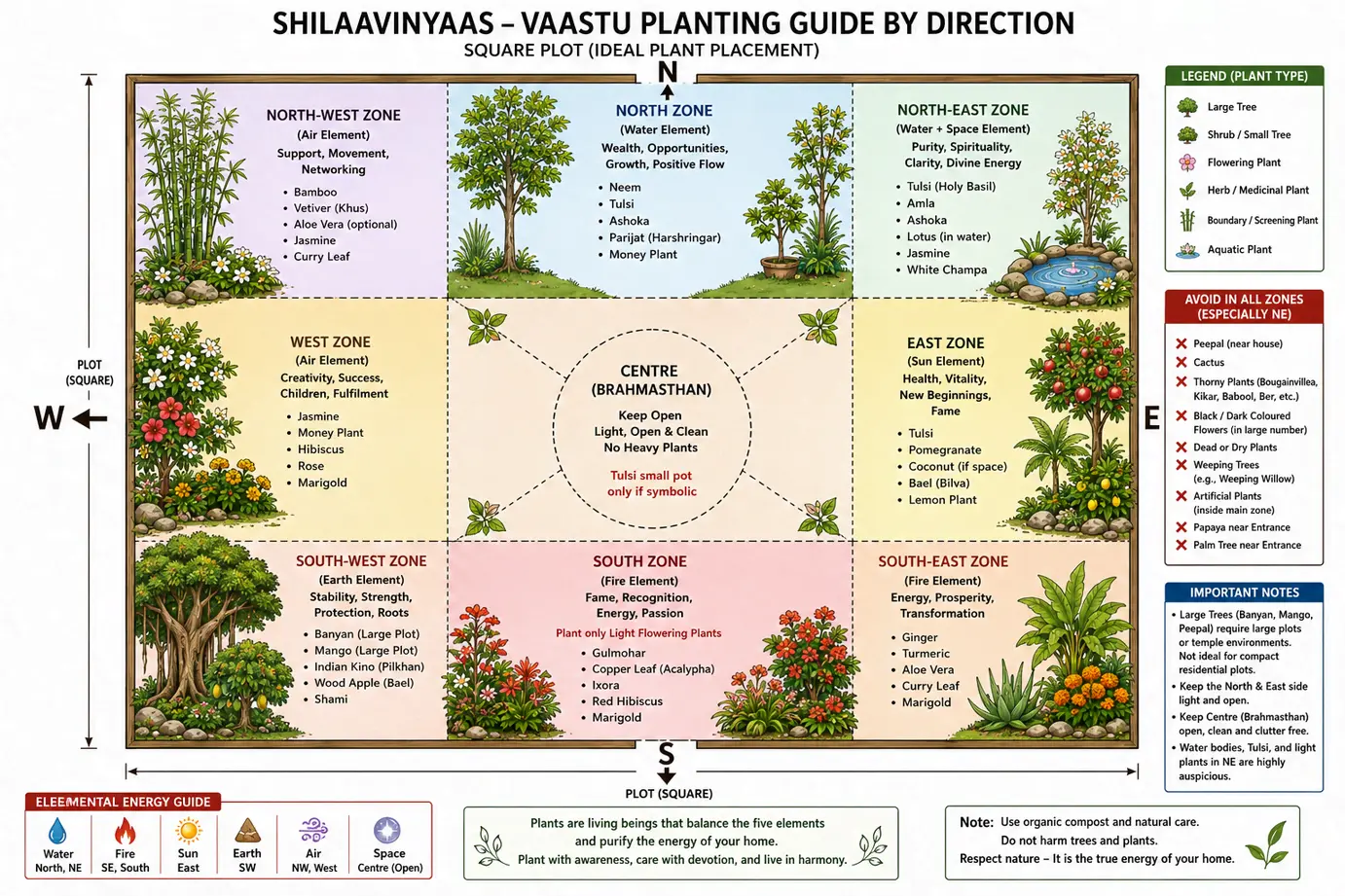
4. Vaastu and Directional Energies
Vaastu states that every direction carries a dominant element:
Direction | Element | Nature | Suitable Plants |
| North (N) | Water | Prosperity, Growth, Career, Opportunities | Money Plant, Mint, Brahmi, Green leafy herbs |
North-East | Water | purity, healing | Tulsi, Jasmine, Amla, Bilva, Lotus,White Hibiscus, Aparajita, Shankhpushpi, Brahmi |
| East (E) | Sun | Vitality, Health, New Beginnings, Recognition | Lemon, Orange, Pomegranate, Coconut (if space permits), Bilva, Tulsi, Ashoka, Aloe Vera (small), Marigold |
South-East | Fire | Energy, Transformation, Digestion, Kitchen Prosperity | Ginger, Turmeric, Curry Leaf (Kadi Patta), Chilli, Aloe Vera, Lemongrass, Banana (small variety), Marigold |
| South (S) | Fire | Fame, Confidence, Passion, Strength | Red Hibiscus, Ixora, Copper Leaf (Acalypha), Gulmohar, Red Marigold, Dragon Plant, Ornamental flowering shrubs |
South-West | Earth | Stability, Protection, Wealth Retention, Authority | Banyan*, Mango*, Chikoo (Sapota), Jackfruit*, Shami, Wood Apple (Bael), Indian Kino (Pilkhan), Jamun*, Neem* (for large plot only) |
| West (W) | Air | Fulfilment, Creativity, Children, Emotional Balance | Jasmine, Rose, Hibiscus (ornamental), Money Plant (trellis), Grapevine (Red/Black), Champa, Fragrant flowering shrubs |
North-West | Air | movement, relationships | Aloe, Vetiver |
Center | Space | balance, consciousness | Tulsi, Jasmine (small pot) |
4.1 Why Directions Matter
North-East receives the first gentle morning light → water element becomes strong here.
South-East gets maximum heat → fire element dominates.
South-West is heavy and stable → ideal for strong-rooted trees.
North-West is airy and dynamic → best for aromatic and fast-moving plants.
The Center must remain open because it represents the space element—pure consciousness.
When plants are matched to their natural direction, the entire home becomes aligned with nature.
5. The 27 Nakshatra Trees Explained Simply
The following list integrates traditional Nakshatra–tree associations with Vaastu-aligned directional energetics, creating a unified placement logic for modern ecological design. Each Nakshatra tree is matched to its ideal directional zone based on elemental dominance, pranic influence, and classical symbolism.
The ancient Nakshatra Vanatradition associates each lunar mansion (Nakshatra) with a specific tree, linking terrestrial ecology with cosmic rhythms. Based on your birth Nakshatra, the list below helps you identify the tree that resonates most closely with your inherent energy signature.
Each tree carries:
- a dominant element
- a specific healing quality
- a direction where it works best
1. ASHWINI
Tree: Poison Nut (Strychnos nux-vomica)
Elements: Fire + Air
Direction:South-East (Agni Kona)
Why: Represents initiation, vitality, ignition.
2. BHARANI
Tree: Amla
Elements: Earth + Water
Direction:North-East (primary), North (secondary)
Why: Nourishment, regeneration, purity.
3. KRITTIKA
Tree: Udumbara / Cluster Fig
Elements:Earth + Fire (corrected unified value)
Direction:South / South-West
Why: Purification, structure, grounded fire.
4. ROHINI
Tree: Jamun
Elements: Earth + Water
Direction:East
Why: Fertility, growth, prosperity.
5. MRIGASHIRA
Tree: Khadira
Elements: Air + Earth
Direction:North-West
Why: Movement, searching, cleansing.
6. ARDRA
Tree: Agarwood / Red Sandal
Elements: Fire + Ether
Direction:South-East or East near altar
Why: Intense purification, mystical vibration.
7. PUNARVASU
Tree: Bamboo
Elements: Air + Ether
Direction:North-West
Why: Renewal, flexibility, returning light.
8. PUSHYA
Tree: Peepal
Elements: Ether + Air
Direction:North-East
Why: Spiritual upliftment, sattva, cosmic breath.
9. ASHLESHA
Tree: Nagakesar
Elements: Water + Fire
Direction:East / South-East
Why: Serpentine energy, psychic intensity.
10. MAGHA
Tree: Banyan
Elements: Earth + Ether
Direction:South-West (Pitru Sthana)
Why: Ancestors, stability, royal lineage.
11. PURVA PHALGUNI
Tree: Flame of the Forest
Elements: Fire + Air
Direction:South-East
Why: Creativity, radiance, celebration.
12. UTTARA PHALGUNI
Tree: Indian Laurel / Ficus
Elements: Earth + Fire
Direction:South
Why: Sustenance, dharma, stable partnerships.
13. HASTA
Tree: Hog Plum
Elements: Water + Fire
Direction:East / North-East
Why: Skill, clarity, healing.
14. CHITRA
Tree: Bilva
Elements: Earth + Air
Direction:North-East
Why: Sacred geometry, symmetry, spiritual order.
15. SWATI
Tree: Arjuna
Elements: Air + Earth
Direction:West (primary), South-West (secondary)
Why: Independence, wind, heart strength.
16. VISHAKHA
Tree: Wood Apple
Elements: Earth + Water
Direction:East
Why: Dual paths, nourishment, decision clarity.
17. ANURADHA
Tree: Bakul
Elements: Water + Ether
Direction:North / North-West
Why: Devotion, fragrance, emotional sweetness.
18. JYESHTHA
Tree: Cane / Rattan
Elements: Air + Fire
Direction:West / South boundary
Why: Authority, discipline, sharpness.
19. MULA
Tree: Sal
Elements: Earth + Fire
Direction:South-West or Outer Grove
Why: Roots, karmic depth, foundation.
20. PURVA ASHADHA
Tree: Guduchi
Elements: Air + Water
Direction:North / North-East
Why: Invincibility (Aparajita Shakti), purification.
21. UTTARA ASHADHA
Tree: Jackfruit
Elements: Earth + Water
Direction:South / South-West
Why: Sustenance, long-term victory, nourishment.
22. SHRAVANA
Tree: Calotropis
Elements: Fire + Air
Direction:West / South boundary
Why: Listening, wisdom, powerful protection.
23. DHANISHTA
Tree: Moringa
Elements: Fire + Air
Direction:South-East
Why: Rhythm, metabolism, prosperity.
24. SHATABHISHA
Tree: Kadamba
Elements: Water + Ether
Direction:North / North-East near water
Why: Healing, mysticism, cleansing.
25. PURVA BHADRAPADA
Tree: Thembavu
Elements: Earth + Water
Direction:South-West or West boundary
Why: Intensity, transformation, protection.
26. UTTARA BHADRAPADA
Tree: Talipot Palm
Elements: Earth + Water
Direction:East or South
Why: Stillness, depth, ancestral blessings.
27. REVATI
Tree: Mahua
Elements: Earth + Water
Direction:South-West or Community Area
Why: Completion, compassion, nourishment.
6. Scientific and Practical Interpretation
6.1 Plants as Pranic Conductors
Plants do the following naturally:
- balance humidity
- purify air
- stabilize soil
- regulate micro-climates
- enhance psychological calmness
Ayurveda calls these qualities Praniceffects.
6.2 Modern Science Supports Ancient Wisdom
Modern botany and environmental science validate many traditional beliefs:
- Peepal and Neem release oxygen even at night.
- Tulsi and Sandalwood release aromatic compounds that reduce germs.
- Banana and water-rich plants cool down the temperature.
- Banyan-like trees improve soil microbes and ground the environment.
6.3 A Building as a Living Organism
Vaastu compares directions to body organs:
| Direction | Body Equivalent | Plants Help By |
| North-East | Kidneys, purification | cooling plants |
| South-East | Digestion | fiery herbs |
| South-West | Skeleton, stability | deep-rooted trees |
| North-West | Breath and movement | aromatic shrubs |
| Center | Mind and hormones | sattvic plants |
Plants act like external organs that keep the building alive and healthy.
7. Design and Environmental Applications
Healing Campuses
Hospitals, schools and wellness centers can design Nakshatra gardensto improve mental health, mood and recovery.
Energy-Efficient Landscaping
Directional placement of plants improves airflow, reduces heat and supports passive cooling.
Cultural and Spiritual Integration
Nakshatra Vana restores a sense of connection between people and ancestral knowledge.
Meditation and Mindfulness Spaces
Ether-rich plants like Tulsi and Jasmine enhance clarity, calm and focus.
These applications demonstrate the relevance of Vaastu Botany as an interdisciplinary design tool for contemporary environments.
8. Direction wise Vaastu Plant chart
Combining Classical Vaastu, Ecological Logic, Elemental Balance & Modern Indoor Plant Science. Vaastu restrictions apply primarily to large trees, dense creepers, and plants that alter light, weight, or pranic movement. Indoor plants that are light, air-purifying, and sattvic remain permissible and even beneficial when placed according to elemental logic.
1. NORTH-EAST (Ishanya) àWater
Allowed (Ideal)
Tulsi
Jasmine / Parijat
Peace Lily
Bilva (small pot)
Amla (outside zone)
Sacred/Fragrant herbs
Not Allowed
Thorny plants
Cactus
Heavy shade trees
Conditional
Kadamba (only outdoors, far corner)
Reasoning
This is the most sattvic, sacred, meditative zone.
Plants must be fragrant, pure, light, devotional.
2. EAST (Purva) àFire + Pranic Upliftment
Allowed
Neem (outside boundary only)
Jamun
Areca Palm
Lotus (water bowl)
Tulsi
Hog Plum
Not Allowed
Creepers covering the East wall
Dense palms blocking morning sunlight
Conditional
Small potted Bilva indoors
Reasoning
East brings morning prana.
Plants should not block the sunrise.
3. SOUTH-EAST (Agni) àFire + Heat
Allowed
Marigold
Ginger / Turmeric pots
Moringa (kitchen side)
Tulsi (secondary position)
Not Allowed
Water-heavy plants
Moisture-loving creepers
Large shade-giving plants
Conditional
Aloe Vera (if not directly blocking fire zone)
Reasoning
This is Agni zone; plants must activate, not cool down the fire.
4. SOUTH (Dakshina) àDharma + Stability
Allowed
Indian Laurel
Jackfruit (far boundary)
Mango (if large plot)
Snake Plant (indoor)
Not Allowed
Creepers
Water storage containers (plants that require saucers with water)
Conditional
Decorative flowers in small pots
Reasoning
South must remain stable, warm, and grounded, not overly moist.
5. SOUTH-WEST (Nairutya) àEarth + Stability
Allowed (indoor light plants)
Jade Plant
Snake Plant
Money Plant (soil-based)
ZZ Plant
Allowed (outdoor only)
Mango
Banyan (large plot)
Sal
Mahua
Not Allowed
Creepers
Light airy plants
Bamboo in SW
This is the most sensitive direction.
Heavy trees allowed only if boundary is strong.
6. WEST (Paschim) àVayu + Detox Zone
Traditional Vaastu discourages heavy or dense vegetation in the West zone due to its role in pranic expulsion and air movement. However, within modern ecological practice, light indoor plants that enhance air purification such as Aloe Vera, Snake Plant, and Spider Plant are acceptable and do not obstruct the natural Vayu flow. The restriction applies primarily to large trees, creepers, or structures that increase shade or weight in this direction.
Indoor plants in West DO NOT create Vaastu dosha
Why?
They have no weight load
No shadow
No root pressure
No architectural impact
No pranic congestion
So the principle remains intact:
“Avoid heavy trees in West but indoor plants that support purification are beneficial.”
Allowed (ONLY light indoor plants)
Aloe Vera
Spider Plant
Snake Plant
ZZ Plant
Not Allowed (clarified)
Large trees
Dense foliage
Creepers
Shade-producing plants
Peepal, Banyan, Mango, Neem
Conditional
Air-purifying plants only
Must not obstruct air flow
Justification
Tradition forbids large, dense plantingbecause West must release stale prana. Small indoor oxygenating plants support this function, not contradict it.
7. NORTH-WEST (Vayavya) àMovement + Relationships
Allowed
Aloe Vera
Bakul
Air plants
Spider Plant
Tulsi (secondary)
Not Allowed
Heavy rooted trees
Creepers
Conditional
Mild fragrant flowers
Small palms
Reasoning
This is an air-movement zone; use plants that sway or purify air.
8. NORTH (Uttara) àMercury + Financial Flow
Allowed
Money Plant
Tulsi
Lucky Bamboo
Aloe Vera
Peace Lily
Not Allowed
Thorny plants
Dark-leafed heavy plants
Large pots blocking financial flow
Conditional
Green leafy herbs
Reasoning
North supports clarity, flow, prosperity—plants should be light, green, fresh.
9. Conclusion
Ayurveda and Vaastu Shastra both describe the world through the same five elements. Ayurveda studies these elements inside the body. Vaastu studies them in the environment. Plants form the bridge between these two truths.
When we:
- understand the elemental nature of plants,
- understand the energy of directions, and
- place plants according to those energies,
the entire space becomes naturally balanced, healthy and spiritually uplifting.
The Nakshatra Vana model shows how cosmic patterns can be planted on the ground to bring prosperity, clarity and stability.
Plants, therefore, function not as decorative elements but as active participants in environmental harmony. They are silent healers, stabilizers and spiritual companions.
This unified approach to Vaastu Botanyblends ancient cosmology with modern ecological science and offers a simple, practical model for future architectural and environmental design.

Leave a comment
Your email address will not be published. Email is optional. Required fields are marked *