
What Should Be Included in Vaastu Gridding and What Should Not?
One of the most common and confusing questions in Vaastu is:
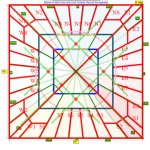
Should a garage, shop, office, servant room or rented portion be included while creating the Vaastu grid (81 Padvinyaas)?
Many people apply thumb rules blindly and end up with wrong Brahmasthaan, false cuts, and incorrect remedies.
Let us clarify this once and for all using classical Vaastu logic with practical reasoning.
The Core Vaastu Principle (Most Important)
Vaastu grid is applied on the Griha Kshetra, not on every built structure.
Griha Kshetra means:
- Space where human life is lived
- Space where daily prana is active
- Space under your control and influence
Vaastu is about energy ownership, not just construction.
Case 1: Garage Attached to the House
Should it be included in Vaastu gridding?
No, in most cases it should NOT be included.
Why?
- A garage is meant for vehicles, not human living
- Human presence is temporary
- Pranic activity is low
- It is a functional, not a living space
Even if the garage:
- Touches the house
- Covers 40 to 60 percent of one wall
- Is structurally attached
It still does not qualify as Griha Kshetra.
Correct approach:
- Exclude garage from the bounding box
- Analyze it separately as a secondary influence
- Check its direction for impact, but do not let it shift the Vaastu center
Case 2: Servant Room or Staff Room
Should it be included?
Yes, if it is livable and regularly used.
Vaastu does not discriminate based on social role.
If a servant room:
- Is used for sleeping or staying
- Has regular human occupancy
- Is structurally integrated with the house
Then it becomes part of human pranic field.
Include it in the bounding box.
When to exclude?
- If it is only a store
- If it is a temporary shed
- If it is completely detached from the main structure
Case 3: Office or Shop Run by the Owner or Family
This is a very important and often misunderstood case.
If the office or shop is run by you or your family:
It must be included in the Vaastu grid.
Why?
- Financial decisions are made there
- Mental and karmic imprint belongs to the family
- Daily pranic activity directly affects prosperity
Even if:
- It is commercial
- Used only during daytime
It still qualifies as extended Griha Kshetra.
Case 4: Rented Office, Shop or House Portion
Should it be included?
No. It should be excluded from your Vaastu grid.
Once a portion is rented:
- Pranic control shifts to the tenant
- Mental and emotional energy is no longer yours
- Vaastu impact becomes indirect
Even if:
- The wall is common
- The floor is same
- The structure is attached
It becomes Paraya Kshetra (external energy field).
Correct practice:
- Exclude rented portions from your bounding box
- Analyze them separately only if required
- Recalculate the grid if tenancy changes
Simple Decision Rule (Remember This)
Include when:
- You live there
- You work there
- Your family controls the space
Exclude when:
- It is rented
- It is for vehicles or services
- It is temporary or non-habitable
Final Takeaway
Vaastu is not about forcing symmetry.
It is about correctly identifying your energy field.
Wrong inclusion creates:
- False Brahmasthaan
- False doshas
- Ineffective remedies
Correct inclusion creates:
- Accurate diagnosis
- Clear understanding
- Long-term stability

Leave a comment
Your email address will not be published. Email is optional. Required fields are marked *