Planetary Objects in Astro Vaastu
How to Identify Planetary Energy Through Objects, Metals, Shapes & Colors in Traditional Indian Vaastu
Ancient Indian Vaastu Shastra and Jyotish Shastra never viewed objects merely as decoration. Every object, material, symbol, shape, metal, and color was believed to radiate a certain graha tattva (planetary vibration).
A sword, lotus, copper vessel, conch shell, electronics, paintings, crystals, perfumes, or even the shape of furniture were traditionally associated with different planetary influences.
Today many modern Vaastu discussions oversimplify these principles. However, classical Indian knowledge systems describe a much deeper relationship between:
- Panchamahabhutas (Five Elements)
- Grahas (Nine Planets)
- Directions
- Metals
- Shapes
- Colors
- Lifestyle Objects
- Human Psychology & Energy Fields
This article attempts to organize those traditional correspondences using references from:
- Brihat Parashara Hora Shastra
- Brihat Samhita by Varahamihira
- Mayamatam
- Manasara
- Samarangana Sutradhara
- Traditional Jyotish Ratna & Graha associations
- Classical Vaastu directional attributes
Understanding the Core Principle
In Astro Vaastu, every planet expresses itself through:
| Planet | Represents |
|---|---|
| Sun | Authority, power, vitality |
| Moon | Emotions, nourishment, fluids |
| Mars | Fire, aggression, tools, machinery |
| Mercury | Communication, intellect, commerce |
| Jupiter | Wisdom, expansion, spirituality |
| Venus | Luxury, beauty, comfort |
| Saturn | Discipline, iron, labor, structure |
| Rahu | Technology, illusion, amplification |
| Ketu | Detachment, mysticism, subtle energy |
Thus, when certain objects dominate a space, they subtly strengthen those planetary vibrations.
Important Clarification Before Applying Remedies
Classical Vaastu texts never recommend blindly placing symbolic objects merely for “instant remedies.”
Traditionally, the effectiveness depends on:
- Direction placement
- Functional use of the space
- Dominant element of the zone
- Natal horoscope compatibility
- Psychological resonance
- Balance between planets
For example:
- Too much Mars symbolism may increase aggression.
- Excess Venus objects may increase indulgence or distraction.
- Overactivation of Saturn may create heaviness or isolation.
- Rahu-heavy technology zones may increase restlessness.
Hence balance is essential.
Planet-Wise Object Identification in Astro Vaastu
1. Ketu Objects in Vaastu
| Attribute | Traditional Association |
|---|---|
| Objects | Medical tools, spiritual objects, disposal systems, healing symbols, isolation-related objects |
| Metals | Mixed metals |
| Colors | Light brown, smoky tones |
| Shapes | Irregular, spreading, abstract |
| Energy Nature | Detachment, healing, moksha, invisible forces |
Traditional Understanding
Ketu is associated with separation, spirituality, hidden sciences, surgery, mysticism, and subtle energies. In classical astrology, Ketu is linked with asceticism and liberation.
Classical References
- Brihat Parashara Hora Shastra associates Ketu with moksha and spiritual tendencies.
- Traditional Jyotish links Ketu with smoky colors and unconventional forms.
Vaastu Observation
Objects related to meditation, healing isolation, spiritual austerity, or abstract symbolism often carry Ketu influence.
2. Venus (Shukra) Objects in Vaastu
| Attribute | Traditional Association |
|---|---|
| Objects | Decor items, perfumes, luxury products, beauty objects, fashion accessories |
| Metals | White gold, silver |
| Colors | Beige, pastel, pink, white |
| Shapes | Symmetrical, elegant, vertical decorative forms |
| Energy Nature | Comfort, luxury, sensuality, attraction |
Traditional Understanding
Venus governs beauty, pleasure, aesthetics, relationships, luxury, fragrance, fine arts, and comfort.
Classical References
- Brihat Parashara Hora Shastra describes Venus as associated with luxuries, ornaments, perfumes, and artistic refinement.
- Shukra Niti also emphasizes refinement and material pleasures.
Vaastu Observation
Elegant décor, fragrances, artistic interiors, fashion products, and hospitality-oriented objects strengthen Venus energy.
3. Sun (Surya) Objects in Vaastu
| Attribute | Traditional Association |
|---|---|
| Objects | Copper objects, authority symbols, power symbols, lighting |
| Metals | Copper, gold |
| Colors | Orange, red, deep gold |
| Shapes | Circular, radiant, expanding |
| Energy Nature | Leadership, vitality, authority |
Traditional Understanding
The Sun represents soul, authority, illumination, government, visibility, and confidence.
Classical References
- Brihat Samhita repeatedly associates Surya with brilliance, copper, royal energy, and visibility.
- Vedic rituals often use copper vessels for Surya-related practices.
Vaastu Observation
Copper décor, royal symbols, strong lighting, flags, emblems, or leadership-oriented décor may amplify Sun energy.
4. Moon (Chandra) Objects in Vaastu
| Attribute | Traditional Association |
|---|---|
| Objects | Water-related décor, silver utensils, soft furnishings, nurturing objects |
| Metals | Silver |
| Colors | White, off-white, light blue |
| Shapes | Curved, flowing, soft |
| Energy Nature | Emotional comfort, nourishment, calmness |
Traditional Understanding
Moon governs emotions, fluids, nurturing, sleep, motherhood, receptivity, and mental peace.
Classical References
- Classical Jyotish associates Chandra with water, silver, milk, and softness.
- Brihat Parashara Hora Shastra describes Moon as nourishing and reflective.
Vaastu Observation
Soft interiors, water imagery, silver décor, rounded furniture, and calming textures are lunar in nature.
5. Mars (Mangal) Objects in Vaastu
| Attribute | Traditional Association |
|---|---|
| Objects | Weapons, tools, electrical systems, mechanical equipment |
| Metals | Copper, iron |
| Colors | Red |
| Shapes | Triangular, sharp, pointed |
| Energy Nature | Fire, aggression, action, engineering |
Traditional Understanding
Mars represents warfare, courage, machinery, heat, fire, and technical force.
Classical References
- Brihat Parashara Hora Shastra associates Mars with weapons, blood, fire, and engineering-like professions.
- Traditional Vaastu also links fire equipment and sharp objects to Mars.
Vaastu Observation
Heavy machinery, gym equipment, electrical systems, weapons, sharp décor, or angular furniture enhance Martian energy.
6. Rahu Objects in Vaastu
| Attribute | Traditional Association |
|---|---|
| Objects | Electronics, CCTV, mobile devices, artificial technology, surveillance systems |
| Metals | Lead-like or mixed industrial metals |
| Colors | Grey, smoky black |
| Shapes | Unusual, head-dominant, asymmetrical |
| Energy Nature | Illusion, amplification, foreign influence, technology |
Traditional Understanding
Rahu governs illusion, obsession, foreign elements, unconventional technology, amplification, and mass influence.
Classical References
- Traditional astrology links Rahu with smoky appearance, unconventionality, poisons, shadows, and foreign systems.
- Modern Astro-Vaastu practitioners often associate advanced technology with Rahu due to its amplifying and artificial nature.
Important Note
Ancient texts obviously do not mention “mobile phones” or “CCTV.” These are modern interpretative extensions based on Rahu’s symbolic nature.
Vaastu Observation
Excessive screens, surveillance systems, artificial lighting, dark metallic décor, or chaotic futuristic designs may increase Rahu influence.
7. Jupiter (Guru) Objects in Vaastu
| Attribute | Traditional Association |
|---|---|
| Objects | Scriptures, religious symbols, educational objects, sacred knowledge |
| Metals | Gold |
| Colors | Yellow |
| Shapes | Broad, balanced, rounded |
| Energy Nature | Wisdom, expansion, ethics, spirituality |
Traditional Understanding
Jupiter represents wisdom, dharma, teachers, ethics, sacred learning, and expansion.
Classical References
- Brihat Parashara Hora Shastra associates Guru with sacred learning, yellow tones, gold, and spirituality.
- Temple architecture often uses broad balanced geometry reflecting Guru principles.
Vaastu Observation
Books, scriptures, teaching spaces, sacred paintings, knowledge centers, and spiritual symbols strengthen Jupiterian energy.
8. Saturn (Shani) Objects in Vaastu
| Attribute | Traditional Association |
|---|---|
| Objects | Iron objects, storage systems, industrial tools, meditation spaces |
| Metals | Iron |
| Colors | Dark blue, black |
| Shapes | Long, thin, restrictive |
| Energy Nature | Discipline, endurance, karmic lessons |
Traditional Understanding
Saturn governs labor, discipline, structure, delays, endurance, austerity, and karmic correction.
Classical References
- Classical Jyotish associates Saturn with iron, dark colors, old objects, and restrictive environments.
- Brihat Parashara Hora Shastra describes Saturn as slow, dry, dark, and disciplined.
Vaastu Observation
Industrial storage, heavy iron furniture, dark interiors, minimalistic meditation zones, or restrictive geometry increase Saturn influence.
9. Mercury (Budh) Objects in Vaastu
| Attribute | Traditional Association |
|---|---|
| Objects | Communication devices, books, writing tools, gadgets |
| Metals | Bronze, mixed metals |
| Colors | Green |
| Shapes | Oval, dual, adaptable |
| Energy Nature | Communication, intellect, trade, analytics |
Traditional Understanding
Mercury governs intellect, speech, commerce, calculation, networking, writing, and adaptability.
Classical References
- Brihat Parashara Hora Shastra links Mercury with speech, learning, trade, and analytical ability.
- Traditional commerce zones were often associated with Budh energy.
Vaastu Observation
Bookshelves, writing desks, communication gadgets, office tools, study areas, printers, and analytical workspaces strengthen Mercury energy.
Important Authenticity Note
Many modern “planet-object” lists circulating online combine:
- Classical Jyotish symbolism
- Tantric symbolism
- Psychological associations
- Modern Astro-Vaastu interpretation
- Contemporary interior design logic
Ancient texts usually explain planets through:
- tattva (element),
- guna,
- color,
- metal,
- direction,
- deity,
- profession,
- temperament,
rather than giving exhaustive interior décor catalogs.
Therefore, authenticity comes from understanding symbolic resonance rather than blindly treating these as rigid rules.
Practical Astro Vaastu Guidance
If You Want More Calmness
Strengthen Moon and Jupiter energies:
- Soft lighting
- Water imagery
- Sacred books
- Yellow-white tones
- Rounded furniture
If You Want More Business Activity
Activate Mercury carefully:
- Organized communication space
- Green accents
- Analytical workspace
- Clean documentation zones
If You Want Authority & Visibility
Strengthen Sun moderately:
- Copper accents
- Balanced lighting
- Leadership symbolism
- East-oriented clarity
If You Want Creativity & Luxury
Enhance Venus:
- Fragrance
- Art
- Elegant décor
- Symmetry
Avoid Excessive Rahu Activation
Too much:
- screen exposure,
- artificial lighting,
- chaotic geometry,
- dark metallic décor,
may psychologically increase restlessness and overstimulation.
Final Thought
Traditional Indian Vaastu was never merely about decoration. It was an attempt to understand how space subtly affects consciousness, behavior, emotions, discipline, relationships, and purpose.
The objects we surround ourselves with continuously reinforce certain psychological and energetic patterns. Ancient sages encoded these observations symbolically through planets, directions, metals, colors, and forms.
When approached with balance, awareness, and authenticity, Astro Vaastu becomes less about superstition and more about creating spaces that align with human nature, rhythm, and intention.
Let's take wiith 1 example:
What This Image Represents in Astro Vaastu
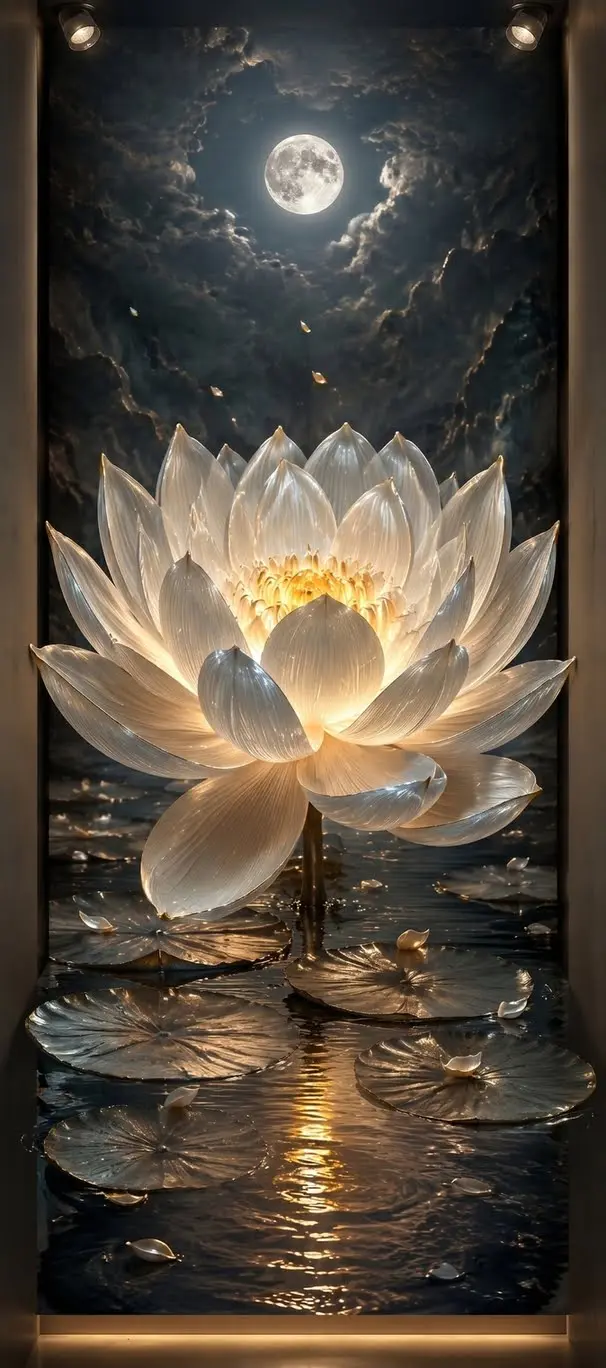
This artwork is highly symbolic and carries a combination of Moon (Chandra), Jupiter (Guru), and subtle Ketu energies.
It is not merely decorative but psychologically and energetically it creates a meditative, emotional, calming, and spiritually elevating atmosphere.
1. Dominant Planet: Moon (Chandra)
The strongest vibration in this artwork is Moon energy because of:
- Full moon imagery
- Water reflection
- White lotus
- Cool luminous tones
- Emotional softness
- Night sky symbolism
- Calm reflective atmosphere
Moon Attributes Activated
| Aspect | Influence |
|---|---|
| Water | Emotional flow |
| White Lotus | Purity & peace |
| Moonlight | Mental calmness |
| Reflection | Introspection |
| Night Sky | Subconscious mind |
| Curved petals | Feminine receptive energy |
Psychological Impact
Traditionally such imagery:
- reduces emotional agitation,
- softens aggression,
- increases contemplation,
- improves emotional sensitivity,
- creates inward awareness.
2. Secondary Planet: Jupiter (Guru)
The blooming lotus itself strongly introduces Guru tattva.
In Indian symbolism:
- Lotus = purity emerging from darkness
- Enlightenment
- Wisdom
- Higher consciousness
- Spiritual unfolding
This is why lotus appears in:
- Lakshmi iconography
- Saraswati iconography
- Buddhist symbolism
- Yogic chakras
- Temple carvings
Jupiter Influence
| Symbol | Meaning |
|---|---|
| Fully bloomed lotus | Expansion of consciousness |
| Golden center glow | Divine wisdom |
| Symmetry | Higher order |
| Sacred geometry | Stability |
3. Subtle Ketu Influence
The mystical cosmic atmosphere, darkness, silence, and transcendental mood introduce subtle Ketu energy.
This creates:
- detachment,
- meditation,
- spiritual depth,
- dream-like perception.
Too much of such imagery in wrong zones may increase:
- isolation,
- emotional withdrawal,
- escapism.
Hence placement matters.
Elemental Analysis
| Element | Presence |
|---|---|
| Water | Very strong |
| Space (Akasha) | Strong |
| Light/Fire | Soft controlled |
| Earth | Minimal |
| Air | Moderate movement through clouds |
This makes the artwork emotionally fluid rather than grounding.
Best Placement as per Astro Vaastu
1. West Zone is Excellent Placement ⭐⭐⭐⭐⭐
This is probably one of the best placements for this artwork.
Why West?
West direction is traditionally associated with:
- introspection,
- emotional maturity,
- fulfillment,
- deeper psychological states,
- Varuna tattva (water association in some traditions).
Moon + water + reflective lotus works beautifully here.
Benefits
- Emotional stability
- Mental cooling
- Spiritual reflection
- Reduced stress
- Better relationship softness
- Elegant premium ambience
Especially Good For
- Living room west wall
- Meditation corner
- Luxury lounge
- Wellness clinic
- Counseling space
- Spiritual office
2. North-West — Good ⭐⭐⭐⭐
Can calm instability and emotional fluctuations.
Good for:
- bedrooms,
- healing rooms,
- therapy spaces.
But avoid overly large sizes here if occupants are emotionally sensitive.
3. North — Good ⭐⭐⭐⭐
Supports:
- mental clarity,
- intuition,
- calm communication.
Works well in:
- study areas,
- consultation cabins,
- creative offices.
4. North-East — Spiritually Powerful ⭐⭐⭐⭐⭐
Very strong placement if used in:
- meditation room,
- prayer area,
- spiritual library.
The lotus + moon combination in NE may create:
- contemplative atmosphere,
- subtle inwardness,
- silence.
However avoid oversized dramatic dark cosmic versions in very small NE spaces.
Placements to Avoid
South-East ❌
SE is fire zone.
This artwork is:
- lunar,
- watery,
- cooling,
- introspective.
Too much Moon in SE may:
- reduce dynamism,
- create emotional overthinking,
- weaken active fire energy.
South-West ❌
SW requires:
- grounding,
- stability,
- earthy authority.
This artwork is:
- floating,
- emotional,
- mystical.
May psychologically reduce decisiveness in SW if oversized.
Commercial Vaastu Interpretation
For commercial interiors, this artwork projects:
| Symbolism | Perception Created |
|---|---|
| Luxury lotus illumination | Premium sophistication |
| Moonlight | Emotional elegance |
| Water reflection | Fluid abundance |
| Large bloom | Expansion & refinement |
| Dark cosmic backdrop | Depth & exclusivity |
Excellent for:
- premium hotels,
- spas,
- wellness centers,
- luxury residences,
- meditation studios,
- high-end reception areas.
Is Moon in West Good as per Traditional Vaastu?
Yes — symbolically it can work very well.
While classical Vaastu texts do not literally say:
“Place moon paintings in west”
the symbolic alignment is valid because:
- West has reflective and emotional characteristics,
- Moon governs mind & emotional fluidity,
- Water-lunar imagery harmonizes with sunset/introspective zones.
This is a symbolic Astro-Vaastu interpretation rather than a literal textual prescription.
Final Astro Vaastu Verdict
| Aspect | Rating |
|---|---|
| Emotional harmony | Excellent |
| Spiritual ambience | Excellent |
| Luxury aesthetics | Excellent |
| Meditation energy | Very high |
| Grounding energy | Moderate |
| Best direction | West / North-East |
| Avoid | South-East & heavy South-West |
Overall Interpretation
This artwork represents:
“Consciousness blooming through emotional stillness.”
It is less about material ambition and more about:
- emotional refinement,
- spiritual beauty,
- inner silence,
- elegant consciousness.
Used correctly, it can become a very powerful emotional anchor within a space.

Leave a comment
Your email address will not be published. Email is optional. Required fields are marked *