What Is Vaastu Shastra?
Vaastu Shastra combines:
- Directional energy
- Natural elements (Earth, Water, Fire, Air, Space)
- Human psychology
- Spatial balance
- Light, movement, and functional zoning
According to traditional belief systems:
- Around 80% of environmental imbalance can be influenced through physical space correction (Bhoutik Shakti / Vaastu).
- The remaining is believed to relate to personal karma, astrology, or destiny (Devik Shakti).
Vaastu emphasizes that:
“If one zone becomes imbalanced, nearby zones are also affected.”
Traditional Vaastu Observations for Emotional Well-Being
Anxiety
Traditional Indicators
- Bedroom in ESE
- Fire imbalance in emotional zones
Suggested Corrections
- Shift bedroom if possible
- Use light cream or light brown tones
- Reduce visual clutter
- Create calming environment
Depression or Emotional Heaviness
Traditional Indicators
- Bedroom in WNW
- Temple in ESE
- Storage in NE
- Toilet in NE
Traditional Remedies
- Remove junk from storage
- Avoid heavy storage in NE
- Use WNW for movement-related objects
- Maintain ventilation and natural movement
Family Harmony Issues
Traditional Indicators
- Bedroom in ESE
- Imbalanced SW zone
Traditionally Suggested Enhancements
- Family photograph in SW
- White horse pair in NW
- Fresh flowers in SE
- Avoid red/orange overload in SW
- Sleep with head towards South or East
Relationship & Marriage Related Vaastu Beliefs
| Issue | Traditional Direction Check |
|---|---|
| Delay in marriage | SW + SE + NW |
| Relationship conflicts | SW imbalance |
| Lack of support | SE imbalance |
| Attraction without conversion | NNW |
| Proposal rejection | NW |
Traditional Suggestions
- Keep SW balanced and clutter-free
- Couple photographs in SW
- Avoid storing wedding gifts in ESE
- Avoid red/pink imbalance in NW
- Use white horse symbols in NW
Child Behavior & Emotional Sensitivity
Traditional Vaastu associates aggressive behavior with:
- Fire imbalance
- SW imbalance
- Excess heat energy
Commonly Suggested Remedies
- Brass tortoise in West
- Nandi in SW
- Deer or rabbit symbolic placement
- Avoid excessive red tones in sensitive areas
Traditional Vaastu & Financial Stability
Loan Burden or Financial Pressure
Direction Traditionally Checked
- NW zone
Common Suggestions
- Remove toilet imbalance
- Avoid red tones
- Keep NW clean and balanced
- White horse imagery facing inward
Business Growth & Brand Awareness
| Zone | Traditional Belief |
|---|---|
| South | Fame & recognition |
| West | Profits |
| North | Opportunity |
| NW | Government support & networking |
Traditional Enhancements
- Red galloping horses in South
- Product catalog in NNW
- Green landscape imagery in North
Village scene in WSW for property-related work
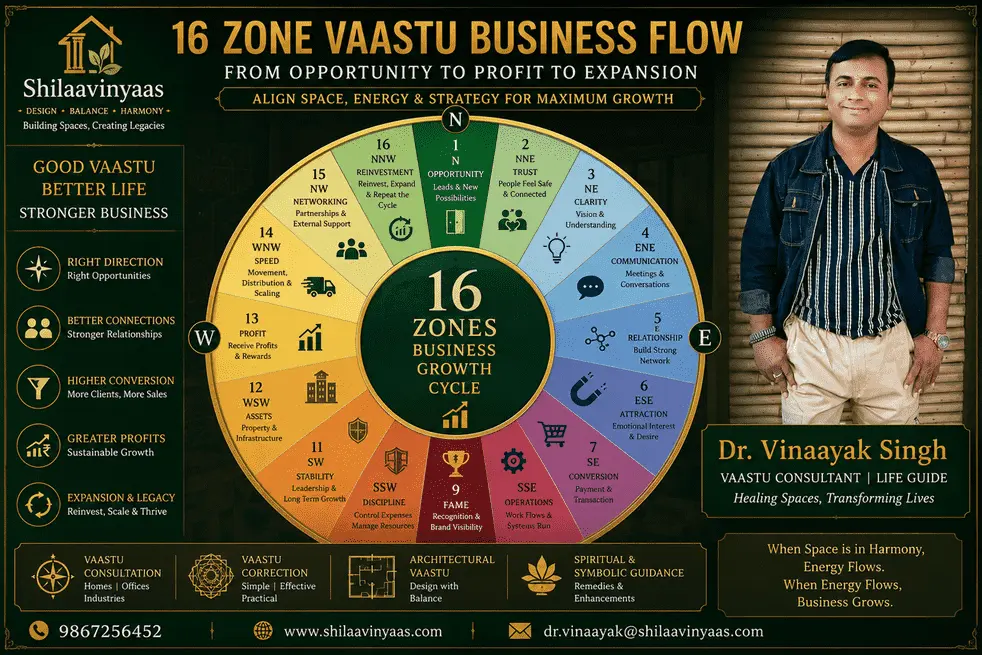
The 16 Direction Vaastu Flow of Business Growth
From Opportunity → Networking → Conversion → Profit → Expansion
Traditional Vaastu does not see business growth as a single event.
It views success as an energetic journey.
According to many traditional Vaastu practitioners, every direction represents a different stage of life and business movement. When these zones are balanced properly, energy is believed to flow naturally from:
- opportunity,
- to connection,
- to conversion,
- to growth,
- to stability,
- and finally to expansion and legacy.
This directional cycle is often interpreted like a business funnel in modern language.
Understanding the Traditional Flow of Business Energy
1. North (N) Opportunity Begins
Represents
- career,
- incoming opportunities,
- visibility,
- movement of prospects,
- new inquiries.
Traditional Understanding
North is considered the entry point of opportunities and business inflow.
If this zone is balanced:
- people notice your work,
- inquiries increase,
- leads begin to come,
- communication channels open.
Common Traditional Suggestions
- Keep North light and open
- Avoid clutter or blockage
- Use blue or white tones
- Maintain cleanliness
Business Interpretation
“North brings the lead.”
2. North-North-East (NNE) Trust & Healing
Represents
- emotional trust,
- human connection,
- comfort,
- recovery,
- reassurance.
After someone discovers you, they first need to feel:
- safe,
- understood,
- and emotionally comfortable.
Business Interpretation
This is where:
- trust building,
- client comfort,
- and emotional connection begin.
“People buy when they feel safe.”
3. North-East (NE) Clarity & Vision
Represents
- clarity,
- intuition,
- planning,
- ideas,
- wisdom.
This is the zone where:
- the customer understands your value,
- confusion reduces,
- and long-term vision forms.
Business Interpretation
NE helps the client think:
“Yes, this is what I actually need.”
4. East-North-East (ENE) Communication & Meetings
Represents
- interaction,
- conversation,
- presentation,
- discussion,
- social engagement.
Traditional practitioners often consider ENE very powerful for:
- meetings,
- interviews,
- brainstorming,
- and communication.
Business Interpretation
This is where:
- presentations happen,
- proposals are discussed,
- networking starts,
- and people begin engaging seriously.
“ENE activates meaningful conversation.”
5. East (E) Relationship Building
Represents
- growth,
- social connectivity,
- reputation,
- public interaction.
East is linked with:
- visibility,
- social acceptance,
- and healthy engagement.
Business Interpretation
At this stage:
- networking strengthens,
- relationships become warmer,
- and brand familiarity increases.
“East converts interaction into relationship.”
6. East-South-East (ESE) Attraction & Emotional Activation
Represents
- attraction,
- desire,
- emotional stimulation,
- excitement,
- engagement.
This is traditionally considered a high-energy zone.
Business Interpretation
Here the prospect becomes emotionally interested:
- “I like this.”
- “This feels valuable.”
- “I want this.”
Marketing, visual branding, storytelling, and emotional appeal are often linked symbolically with ESE.
7. South-East (SE) Conversion & Financial Movement
Represents
- fire,
- execution,
- money flow,
- action,
- transaction.
SE is considered one of the strongest business zones because it activates:
- decision-making,
- implementation,
- payments,
- and business momentum.
Business Interpretation
This is the actual:
- conversion,
- purchase,
- payment,
- or business closing stage.
“SE converts interest into transaction.”
8. South-South-East (SSE) Cash Flow & Operations
Represents
- operational energy,
- daily business movement,
- productivity,
- running systems.
Business Interpretation
Once conversion happens:
- delivery starts,
- operations run,
- teams execute,
- and cash flow begins moving.
Balanced SSE is traditionally believed to:
- improve consistency,
- reduce waste,
- and stabilize workflow.
9. South (S) — Fame & Recognition
Represents
- name,
- recognition,
- authority,
- public identity,
- confidence.
Business Interpretation
This is where:
- your brand becomes known,
- recognition increases,
- reputation grows,
- and visibility strengthens.
This is why red horses are traditionally suggested in South.
“South amplifies recognition.”
10. South-South-West (SSW) Discipline & Resource Stability
Represents
- resource management,
- stability,
- control,
- financial discipline.
Business Interpretation
This stage determines whether:
- profit is wasted,
- or stabilized.
SSW is linked with:
- expenditure control,
- financial grounding,
- and structured growth.
11. South-West (SW) Long-Term Stability & Leadership
Represents
- ownership,
- leadership,
- long-term stability,
- trust,
- emotional grounding.
Business Interpretation
This is where business becomes:
- stable,
- respected,
- trusted,
- and sustainable.
SW is often considered the foundation zone of lasting success.
“SW sustains what SE creates.”
12. West-South-West (WSW) Assets & Property
Represents
- land,
- property,
- accumulation,
- fixed assets,
- legacy building.
Business Interpretation
At this stage:
- business starts acquiring assets,
- investments happen,
- property grows,
- infrastructure expands.
Traditional village paintings or land symbols are sometimes used here.
13. West (W) Profit & Fulfillment
Represents
- fulfillment,
- profits,
- rewards,
- outcomes.
Business Interpretation
This is where effort finally converts into:
- real profit,
- satisfaction,
- and tangible outcomes.
Traditional Vaastu often associates West with:
“receiving the fruits of effort.”
14. West-North-West (WNW) Speed & Market Movement
Represents
- movement,
- speed,
- distribution,
- circulation,
- expansion.
Business Interpretation
This stage supports:
- faster execution,
- product movement,
- distribution,
- and scaling activity.
Traditionally deer symbols are sometimes associated here for speed.
15. North-West (NW) Support, Networking & Expansion
Represents
- external support,
- partnerships,
- networking,
- social movement,
- institutional support.
Business Interpretation
This is where:
- partnerships happen,
- investors connect,
- government support comes,
- collaborations grow.
NW is traditionally considered the zone of external movement and support systems.
“NW expands the ecosystem.”
16. North-North-West (NNW) Reinvestment & Market Circulation
Represents
- reinvestment,
- circulation,
- market spread,
- repeat movement.
Business Interpretation
At this stage:
- profits get reinvested,
- brand spreads,
- repeat customers emerge,
- and growth enters a new cycle.
The journey returns back toward North again:
- new opportunities,
- bigger visibility,
- stronger brand presence.
And the cycle continues.
The Traditional Vaastu Business Cycle
| Direction | Business Stage |
|---|---|
| North | Opportunity |
| NNE | Trust |
| NE | Clarity |
| ENE | Meetings & Communication |
| East | Relationship Building |
| ESE | Attraction |
| SE | Conversion & Payment |
| SSE | Operations & Cash Flow |
| South | Fame & Recognition |
| SSW | Financial Discipline |
| SW | Stability & Leadership |
| WSW | Assets & Property |
| West | Profit |
| WNW | Speed & Distribution |
| NW | Networking & Expansion |
| NNW | Reinvestment & Growth Cycle |
A Modern Interpretation
Whether viewed spiritually or psychologically, this directional flow mirrors modern business reality surprisingly well:
- visibility creates leads,
- relationships create trust,
- trust creates conversion,
- conversion creates cash flow,
- discipline creates stability,
- stability creates profit,
- profit creates expansion,
- expansion creates reinvestment.
Traditional Vaastu expresses this through the language of directions and energy.
Modern business expresses it through:
- branding,
- sales funnels,
- customer psychology,
- operations,
- and scaling systems.
Different language.
Very similar human behavior.

Leave a comment
Your email address will not be published. Email is optional. Required fields are marked *