The AI bubble is about to burst. That is what many in Silicon Valley are saying. Maybe true, maybe not. But what is true is this: last year, 650 billion dollars went into AI, and 1.1 million jobs disappeared at the same time.
We have seen cycles like this before. Real estate. Crypto. And now AI. The story is always the same. The smart ones, the top 1 percent, position themselves early and win whether the crash comes or not, while the rest suffer.
This is the exact playbook to stay ahead, become harder to replace, and futureproof a career before it is too late.
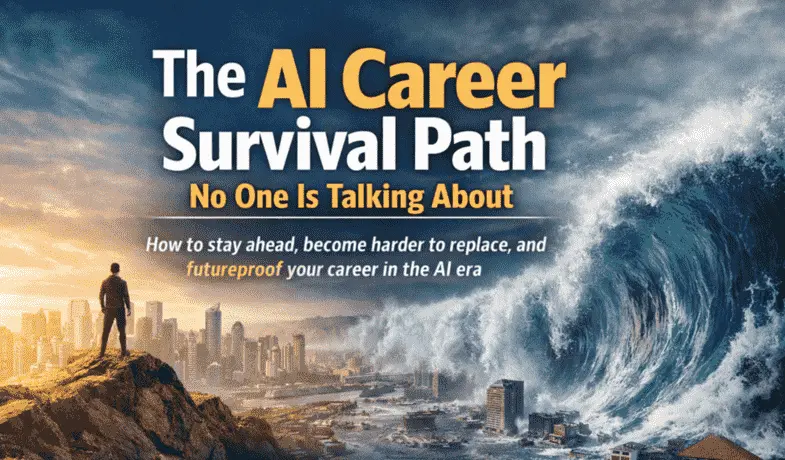
The AI Tsunami Has Already Started
Imagine standing on a beach. The ocean suddenly pulls back. You look down at your ankles and think, “Well, I’m dry. Looks perfectly safe.”
But a thousand miles away, sensors show a wall of water racing toward shore at 500 miles an hour. That is what happens in every single tsunami. And that receding water moment is exactly where we are with AI right now.
Shane Le, co founder of Google’s DeepMind, puts it very bluntly. If your job is 100 percent done on a laptop, you are competing with AI that costs pennies.
As this AI tsunami reaches society, it creates two zones. The high ground, where the 1 percent survive and capture millions in wealth and success. And the flood zone, where perhaps 99 percent of people will end up standing.
The real question is simple. Which zone is someone standing in right now?
How To Know If You Are In The Flood Zone
I watched an AI product demo last month. Beautifully designed. Lightning fast responses. Cutting edge AI at the back end. But when asked how many customers use it daily, there was silence. The answer: “We’re not ready for prime time yet.”
Translation: a million dollar science project. Great demo. Zero customers. Zero cash. That is the flood zone reality.
To recognize the flood zone, use a framework called RAIL. Four questions. About 50 seconds to answer.
R is Revenue
Is the AI used by real paying customers? If the answer is “we’re still piloting” or “eventually we’ll get there,” that is a red flag. If someone is leading a project with no clear revenue path, they are first on the chopping block. No revenue, no boat.
A is Acceleration
Can something real be delivered to customers in two weeks? If not, someone else will. The question becomes: where is the friction and how can AI remove it? If there is no real improvement in speed and efficiency, it is flood zone territory.
I is In Market
Even internal tools must be in the hands of real users, gathering real data. If a product is sitting on a shelf in a test environment, it is not a business asset. It is a hobby.
L is Learning
One week of watching customers break a product teaches more than six months of internal testing. The pace of AI is so feverish that if a team is not constantly learning, it is already losing.
Companies like Cursor refine their product daily, launching new features every single day. That is the velocity of innovation everyone must get used to.
If the answer is no to at least two of these four questions, the company or project is likely in the flood zone.
The Map Most People Never See
The AI world looks chaotic from the outside. Orchestration layers. Vector databases. Tensor chips. But the noise hides a simple map with three layers where money is actually made.
Layer 1: Infrastructure
Chip makers, cloud providers, energy providers. This is a game of massive capital. Unless someone is Nvidia level or backed by sovereign funds, it is nearly impossible to win here.
Layer 2: Frontier Models
ChatGPT, Claude, Gemini, XAI. This layer is consolidating fast. Features are copied. Prices per token have dropped by 98 percent in 18 months. Open source models are closing the gap at a fraction of the cost.
Starting a new frontier model company today makes as little sense as launching a new internet search engine during Google’s dominance.
Layer 3: Apps and Services
This is the interface and the solution layer. This is where value is captured. This is where individuals and smaller companies can build something amazing.
There are three opportunities inside this layer:
- Horizontal AI apps that serve everyone
- Vertical AI apps that dominate a niche
- AI services focused on implementation and integration
Some boutique firms charge 50,000 dollars a month just to help companies plug AI into workflows. They are not building software. They are implementing it. They are experts who set it up.
Knowing the map is not enough. The next challenge is avoiding the potholes.
The Job Apocalypse Is Not Here Yet, But It Is Coming
Hiring has slowed, but companies are still hiring. The companies laying people off first are also the earliest adopters of AI. Microsoft. Amazon. Meta. Google. They are cutting non AI roles to fund AI talent.
If a job exists only to maintain the status quo, it is in the flood zone. AI will automate scripted work. Survival depends on owning the strategic parts of a role.
This applies to engineers, consultants, data annotators, accountants, analysts. Scripted work gets automated. Strategic judgment stays human.
The Three Step Action Plan
Step 1: Audit the job
Divide the day into scripted and strategic work. Scripted work includes repetitive processing, summaries, boilerplate emails, standard code. Strategic work includes solving new problems, designing systems, building relationships, catching edge cases.
Step 2: Fire yourself from scripted work
Automate it before the boss does. Remove dependence on repetitive tasks.
Step 3: Reinvest in the human edge
Deep thinking requires silence, not scrolling. Imagination, not constant information. Long walks, reflection, daydreaming. This is where new connections are formed and unique insights appear.
But habits alone are not enough. Mindset matters.
The Three Rs Of The Top 1 Percent
The people who reach high ground share three traits: rigor, relationships, and resilience.
Rigor
Deep mastery of domain, process, and data. Open Evidence became worth 3.5 billion dollars and is used by 40 percent of US doctors because of rigorous peer reviewed refinement. A BCG and Harvard study showed consultants with deep domain knowledge using GPT achieved 40 percent better results than those without.
Surface knowledge is no longer enough. Depth is the advantage.
Relationships
In a world where AI can generate anything, humans must generate trust. Careers are built on relationships, not resumes. Listening, presence, and genuine connection shape opportunities more than credentials.
Resilience
Every inspiring story is a comeback story. Steve Jobs. Shah Rukh Khan. Nelson Mandela. Setbacks are waves. Roles, markets, and technologies rise and fall. The substance that remains is rigor, relationships, and resilience.
A teacher once said: you think you are a wave, but you are water. Titles and technologies are waves. Character is the ocean.
Let the tsunami come. Waves will crash. In the long run, those anchored in rigor, relationships, and resilience survive and thrive.
There is still time to find high ground.
Credit to YouTube creator @theMITmonk for the powerful insights that inspired this article on navigating the AI career shift.
Vibe Coding:
| Earlier: | Now: |
| Product managers defined requirements Engineers translated them into code Development cycles were long and expensive | One person can go from idea to working product AI plans, scaffolds, codes, tests, and iterates Feedback happens in real time through conversation |
| To build an app required: Budget Engineers 6–12 months | One sharp product thinker with AI can build: MVP in days Niche tools in hours |
| Can you code? | Can you think clearly about the product? |
The skill shifts from:
“Can you code?”
To:
“Can you think clearly about the product?”
| Old World: | Current World: | Future World: |
| Best coder wins. | Best product thinker wins. | Best taste + clarity + system thinker wins. |
The AI handles syntax.
Humans handle:
Judgment
Direction
Vision
Trade-offs

Leave a comment
Your email address will not be published. Email is optional. Required fields are marked *