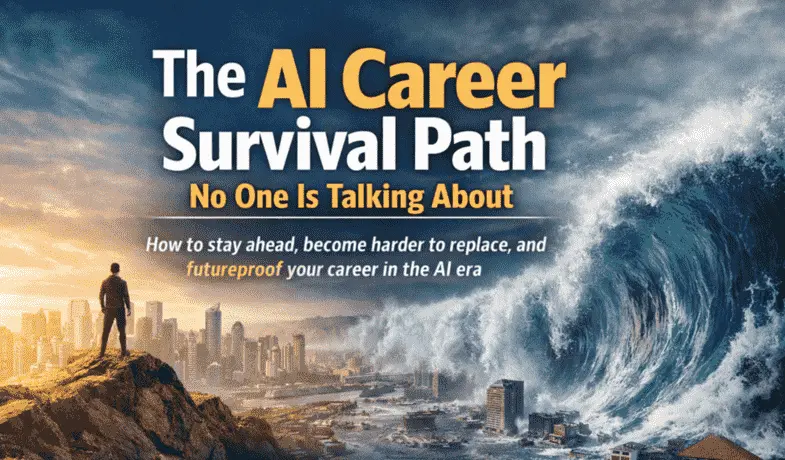



Introduction: AI Is Not Replacing You, Inefficient Use of AI Is
Most people fear AI because they think it will replace them.
The truth is simpler and sharper.
AI is not the threat. People who know how to use AI effectively are.
The gap between those who understand AI and those who don’t is widening faster than any technology gap in history.
And right now, you are not behind. You still have time. But not much.
This is your 30 day roadmap to rise into the top 1 percent of AI users.
Why Most People Fail With AI
Most people talk to AI as if they are talking to a human.
They type vague requests.
They expect perfection.
They blame the model when the output is weak.
The truth is direct.
If your prompt is vague
AI will guess
And when AI guesses
You get vague results
Because generative AI does not understand like humans.
It predicts the next most likely token based on mathematical closeness inside a massive vector space.
So the real game is simple:
If you learn how AI thinks
you learn how to make AI think for you.
Week 1: Learn Machine English – The Language AI Actually Understands
AI does not read your sentence like a human.
It breaks your text into tokens
turns them into numbers
places them in an embedding space
and predicts the next token.
So the trick is to speak to AI in a form it can compute.
This is where the AIM Framework comes in.
AIM Framework
A – Actor
Tell the model who it is.
“You are a world class product strategist.”
“You are an expert resume editor.”
“You are a senior Python engineer.”
AI performs like the persona you assign.
I – Input
Give context, data, files, examples, requirements.
AI without context is like GPS without destination.
M – Mission
Tell exactly what you expect.
Format.
Tone.
Output style.
Length.
Goal.
This one formula alone boosts output quality by 10X.
Let me clarify, How Ancient Puranic Prayers Already Followed the AIM Framework
When Draupadi called Krishna during her deepest crisis, she used the exact structure that today we call the AIM Framework.
This proves that powerful communication, whether with the Divine or with AI, follows a timeless pattern:
A → Actor
I → Input
M → Mission
Here is the mapping:
A = Actor
(Telling AI who it is → Telling God who He is)**
In AIM, we tell the AI:
“You are a world class expert…
You are an award-winning writer…”
In Puranic prayer, the devotee does the same:
Draupadi begins by defining the “Actor”:
“हे कृष्ण, द्वारकानाथ, गोविन्द, रक्षक, दीनबन्धु!”
(You are the supreme protector… the Lord of compassion…)
This is exactly like assigning a persona.
She tells Krishna who He is, what His nature is, and what role He must step into.
This aligns with the “A” of AIM: Declare the role of the Higher Intelligence.
I = Input
(Providing context → Presenting past miracles and the current situation)
In AIM, Input means giving:
• background
• data
• files
• problem details
Draupadi provides two layers of Input:
1. Inputs from history (Purva Katha Smaran)
She recalls earlier divine interventions:
“You lifted Govardhan…
You saved Gajendra…
You protected Prahlad…”
These past miracles act as context, just like providing case studies to AI.
2. Inputs from the current problem (Aapad Varnan)
“My dignity is being destroyed…
No one supports me…
I am powerless…”
This is exactly like giving AI the real-time situation or pain point.
This step perfectly maps to the “I” of AIM: Give context + data + scenario.
M = Mission
(What we want AI to do → What we ask God to do)
In AIM, Mission is where you give a clear goal:
“Write this…
Fix this…
Optimize this…”
Draupadi ends with a clear mission:
“Protect me.
Save my honor.
You are my only refuge.”
She clearly states:
• what outcome she wants
• what action she needs
• where divine power is required
This aligns with the “M” of AIM: The explicit requested action.
Week 1 Goal
Be able to write structured prompts without thinking.
Once AIM becomes muscle memory, you enter the top 10 percent.
Week 2: Master Context With MAAP – The Secret Behind Smart Outputs
Even the best AI sounds average without rich context.
Context is the oxygen for generative reasoning.
Use the MAAP Framework.
M – Memory
Paste previous parts.
Tell AI what the past conversation included.
Build continuity.
A – Assets
Attach files, data tables, notes, research, examples.
Assets ground AI into your reality.
A – Actions
Use available tools:
web search, code execution, file scanning, etc.
P – Prompt
The explicit instruction itself.
With MAP, you build intelligence into your prompt.
Your output becomes deeper, grounded, trustworthy.
How Ancient Puranic Prayers Also Reflected the MAAP Framework
Just like the AIM framework appears in ancient prayers, the MAP framework is also deeply embedded in the way devotees communicated with the Divine.
M → Memory
A → Assets
A → Actions
P → Prompt
Let us map this to Draupadi’s prayer to Krishna.
1. M = Memory
(What the system already knows)
In MAP, Memory means recalling past interaction or past knowledge.
Draupadi begins her prayer by invoking Krishna with names that recall their past relationship and emotional memory:
“गोविन्द, सखा, द्वारकानाथ, माधव…”
These names unlock:
• the emotional memory between Krishna and the Pandavas
• the unbreakable bond between Draupadi and Krishna
• the past moments where Krishna protected them
This is exactly like telling an AI:
“Use earlier conversation.
Use previous context.
Use past commitments.”
Draupadi triggers Krishna’s Memory of their divine sambandh.
2. A = Assets (Evidence, references, earlier examples)
In MAP, Assets are the data, examples, files, proofs, grounds on which the answer stands.
Draupadi provides Assets by listing the miracles Krishna had performed earlier:
“You saved Gajendra…
You lifted Govardhan…
You protected Prahlad…
You revived Sandipani’s son…”
These are not praises.
These are case studies.
Ancient “Assets”.
This is exactly like giving an AI:
• past outputs
• research references
• examples
• proof
• historical data
She uses Assets to strengthen the foundation of her request.
3. A = Actions
(Resources, divine tools, capabilities to be invoked)
In MAP, Actions means using available tools or abilities.
In ancient prayer, this step is when the devotee reminds God of His powers and tools.
Draupadi implicitly activates Krishna’s divine Actions:
• Sudarshan Chakra
• His omnipresence
• His power to intervene instantly
• His limitless Shakti
• His commitment to Dharma
• His vow to protect His devotees
She is indirectly telling Him:
“Use Your divine resources.
Engage Your powers.
Take the necessary action.”
This is equivalent to enabling AI tools like:
• web search
• code execution
• file reading
• function calling
She is saying:
“Krishna, use whatever divine capabilities are needed.”
4. P = Prompt
(The final instruction or request)**
In MAP, Prompt is the explicit instruction.
Draupadi ends with absolute clarity:
“Protect me.
Save my honor.
You are my only refuge.”
It is direct.
It is precise.
It is emotionally clear.
It gives a single mission.
This is exactly the Prompt in MAP.
Week 3: Debug Your Thinking – Not AI
Most beginners think AI is wrong.
Experts assume their prompt is wrong.
This is the mindset shift.
If AI output is weak, ask yourself:
Did I define the persona
Did I provide context
Did I specify the mission
Did I show examples
Did I ask for reasoning
You are not typing.
You are iterating.
Use these three debugging cheat codes:
1. Chain of Thought Pattern
“Think step by step. Show reasoning. Then give the final answer.”
2. Verifier Pattern
“Ask me three clarifying questions before answering.”
3. Refinement Pattern
“Propose two sharper versions of my question. I will pick one.”
You and AI improve each other through refinement loops.
This alone separates world class AI users from casual ones.
Week 3 Goal
When you can diagnose your own prompts, you break into the top 5 percent.
Week 4: Steer the AI Into Expertise
AI is a probability machine.
If you give vague prompts, you will get generic content.
To get depth, you must pull the AI toward expert zones.
Example:
Instead of
“How do I build an innovative team”
Ask:
“Using Pixar Braintrust, Satya Nadella’s strategy and Harvard research
explain how to build an innovative team.”
Suddenly, AI stops sounding generic
and starts sounding like a PhD researcher.
If you don't know the experts?
Ask AI:
“List top experts and research in this field.”
Then feed that list back into your prompt.
This is how you get expert-level reasoning without being an expert.
Verification: How to Separate Truth From Confident Nonsense
Generative AI can make things up.
Confidently.
Smoothly.
Beautifully.
Verification protects you.
Use these five tools:
1. Assumptions
“List your assumptions and rank them by confidence.”
2. Sources
“Provide two independent sources with URLs and quotes.”
3. Counter Evidence
“Find one credible source that disagrees.”
4. Auditing
“Show your math. Recalculate everything slowly.”
5. Cross Model Verification
Ask Claude to critique ChatGPT.
Ask Gemini to audit Claude.
Feed outputs across models.
Truth emerges from synthesis.
Classic Example: Hiranyakashipu’s Verification of His Boon From Brahma
Hiranyakashipu did intense tapasya.
Brahma appeared and offered a boon.
But Hiranyakashipu did not simply ask
“Make me immortal.”
He knew that was not allowed.
So he used Verification Logic the way an expert would refine a prompt.
He asked:
“I should not be killed
by any man
any animal
any weapon
inside the house
outside the house
during day
during night
on earth
in the sky.”
This is exactly like a prompt engineer removing ambiguity.
Hiranyakashipu basically said:
“List every possible edge case that could violate my immortality,
and eliminate it.”
This is the perfect ancient example of:
● boundary checking
● assumption removal
● edge-case validation
● counter-example elimination
● final verification
Even the Gods respected the precision of his request.
And yet
God left one loophole –
Because Hiranyakashipu never asked:
“What about something that is NONE of these categories?”
Verification reveals truth.
Lack of verification leaves unseen gaps.
Narasimha emerged
neither man nor animal
neither inside nor outside
neither day nor night
neither ground nor sky.
This shows:
If your verification is incomplete,
the universe will find the gap.
Which is EXACTLY what happens with AI hallucination, wrong assumptions and vague prompts.
Another Example: Ravana’s Boon From Brahma
Ravana also verified his boon like a master strategist.
He said:
“Make me invulnerable to Devas, Gandharvas, Yakshas.”
But Ravana made a verification mistake.
He thought humans were too weak
so he did not include them in his “protection list.”
This is a perfect parallel to AI verification:
If you forget one variable,
the whole system breaks.
Shri Rama took advantage of the missing assumption
exactly like a bug exploiter.
This is why your verification phase in AI must include:
• Missing constraints
• Edge cases
• Forgotten variables
• Unintended gaps
Even Asuras who controlled half the universe
lost battles because they did not verify one small detail.
Final Week: Develop Taste – Your Unique Voice
The top AI users do not sound like AI.
They sound like themselves.
This is the art.
Use the OCEAN Framework.
O – Original
Look for non obvious ideas.
Ask AI to propose 3 rare angles.
C – Concrete
Ask for examples, names, numbers.
E – Evident
Ask for logic in bullets.
Ask for proof.
A – Assertive
Ask AI to pick a side and defend it.
N – Narrative
Make it flow like a story.
Hook, problem, insight, proof, action.
When you apply OCEAN, your AI work becomes world class.
How the OCEAN Framework Already Exists in Ancient Puranic Narratives
The OCEAN framework creates writing that is:
Original
Concrete
Evident
Assertive
Narrative
Surprisingly, this is exactly how our ancient Puranas were structured.
Let us correlate each part:
1. O = Original
(Unique angle, uncommon insight)
Puranas are full of original, never-seen-before scenarios.
• Narasimha – a form neither human nor animal.
• Vamana – God becoming a dwarf child to defeat an emperor.
• Mohini – Vishnu taking an enchanting form to outsmart Asuras.
• Kurma – God becoming a tortoise to hold the Mandara mountain.
Every event has an unexpected, innovative twist, something no one could predict.
This aligns perfectly with O in OCEAN:
→ Always bring a unique, uncommon angle.
This is why Puranic stories stay alive for thousands of years
and why your AI content must carry originality.
2. C = Concrete
(Real examples, vivid details)
Puranas never speak in abstract theory.
They use concrete, sensory details:
• the exact forest where tapasya was done
• description of weapons
• the glow of divine forms
• number of days of penance
• the exact vows made
• the specific boons granted
• the cosmic environment around them
Example:
When Gajendra called Vishnu,
the Bhagavat Purana gives precise details:
• the lotus lake
• the crocodile attack
• the pain of Gajendra
• the exact shloka he recited
This is C in OCEAN:
→ Use details, examples, names, places, sensory visuals.
It creates sharpness and authenticity.
3. E = Evident
(Logic, reasoning, proof of claim)
Puranas always show clear reasoning and consequence chains:
• Hiranyakashipu’s boon had loopholes, so Narasimha was the logical counter.
• Prahlad’s devotion had evidence through repeated miracles.
• Ravana’s arrogance logically led to downfall.
• Krishna’s guidance to Arjuna is filled with reasoning, logic and layered proof.
Every story explains why something happened.
This is E in OCEAN:
→ Provide reasoning, logic, and evident causal links.
Puranic stories are not random miracles.
They are structured, logical spiritual psychology.
4. A = Assertive
(Choose a side, strong opinion)
Puranas never stay neutral.
They strongly state:
• Dharma must win
• Ego destroys
• Surrender protects
• Truth is non negotiable
• Arrogance invites downfall
• Devotion transforms destiny
• Time punishes injustice
This is the assertive voice.
No hesitation.
No “maybe”.
No “possibly”.
This is A in OCEAN:
→ Take a stand.
→ Speak clearly and confidently.
Assertiveness is why Puranas influence billions even today.
5. N = Narrative
(Flowing story, emotional arc)
Every Purana is built as a narrative arc:
• A challenge
• A crisis
• A surrender
• A divine intervention
• A resolution
• A lesson
Examples:
• Gajendra Moksha
• Dhruva’s tapasya
• Prahlad’s protection
• Sita Haran to Agni Pariksha
• Samudra Manthan story
• Markandeya escaping death
These stories follow the same narrative structure that modern storytelling, screenwriting and branding uses.
This is N in OCEAN:
→ Use emotion, story structure, tension, release, moral.
A narrative makes knowledge unforgettable.
Final OCEAN Mapping Table: Puranic Model vs AI Writing Model
| OCEAN Step | AI Meaning | Puranic Equivalent |
|---|---|---|
| O – Original | Unique angle | Narasimha, Vamana, Mohini, Kurma forms |
| C – Concrete | Examples, details | Specific locations, weapons, shlokas, events |
| E – Evident | Logic and proofs | Causal reasoning, karmic justice, cosmic rules |
| A – Assertive | Strong view | Dharma will win, adharma will fall |
| N – Narrative | Story arc | Crisis → Surrender → Divine help → Victory |
The Real Transformation: AI Is Not Here To Replace Work; It Is Here To Restore Worth
Every prompt you write
every revision you make
every expert you reference
every assumption you challenge
every context you provide
every audit you verify
you are not just training AI.
You are training your own mind.
AI does not eliminate thinkers.
AI eliminates those who stopped thinking.
You are not behind.
But the world is moving fast.
If you start now, consistently for 30 days
you will rise above 99 percent of people who only “use AI casually”.
Your future depends on how you use this moment.
Take control.
Start today.
Awaken your mind.
Shape your destiny.

Leave a comment
Your email address will not be published. Email is optional. Required fields are marked *